Skip to content

Author: anthony

Joint briefing with the Chair of the Brook House Inquiry

Places of detention are the hidden spaces in our society… They are places where communication is restricted, rights and freedoms are curtailed, where isolation from loved ones is a fact of life, and where the toll of detention can have an impact on people’s mental and physical wellbeing. For anyone who has been detained by the State, it is a profoundly life-altering experience.

(Brook House Inquiry Report, Vol. 1, p.1)


On Tuesday 29 November 2023, the APPG on Immigration Detention – for which Medical Justice provides the secretariat – and APPG on Migration jointly held a briefing for Members on the Brook House Inquiry Report, with the Chair of the Inquiry, Ms Kate Eves.

The Brook House Inquiry is the first ever statutory inquiry on immigration detention in the UK. Set up to investigate abuse revealed by the BBC at Brook House Immigration Removal Centre (IRC) in 2017, the Inquiry has also gathered evidence on the systemic failings – in terms of policies, practice, and culture – which allowed that abuse to occur.

The Chair of the Inquiry, Ms Kate Eves, published her final report in September 2023. Its carefully evidenced analysis shines a vital light into the “hidden space” of immigration detention.

Many of the problems identified within the report are continuing today across the UK’s detention system. It is crucial reading for anyone seeking to understand the ongoing failures in detention, their devasting effect on detained individuals, and what needs to change.

The joint APPG event was an opportunity for Members to learn more about the important issues raised in the Inquiry’s final report, and to assess its implications for the use and operation of immigration detention in the UK going forward. Members also discussed ways to raise awareness of the Report in Parliament, and to monitor government implementation of its recommendations.


Access a full copy of the meeting minutes here.


The Inquiry Report and APPG event have come at a particularly salient time, with the Illegal Migration Act 2023 granting the Home Secretary even greater powers to detain individuals, including children, whilst at the same time dramatically reducing the avenues available to people to challenge their detention. Alongside these legislative changes, the Home Office has also announced plans to significantly expand the detention estate – including increasing capacity at current sites and opening new ones. Based on these developments, it appears that the government going forward intends to detain greater numbers of people under immigration powers in the UK, for longer periods of time.

Additional links of interest:

  • Further correspondence published by the Inquiry can be accessed here.

Induction Training Day For Interpreters – March 2024

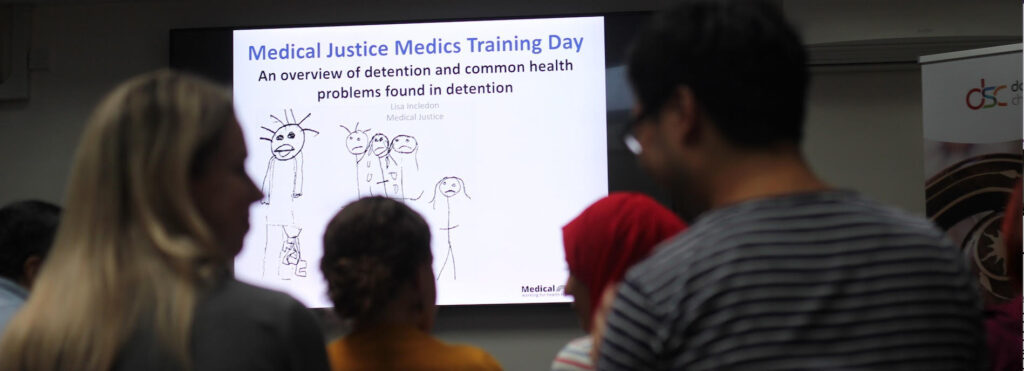
Our Induction Training Day is for new volunteer interpreters who are joining Medical Justice. By joining Medical Justice as a volunteer interpreter, you can have a positive impact on the lives and health of a vulnerable group of people in the UK. Our interpreters help people in detention seek support and advice despite the language barriers and provide crucial interpretation for medical assessments with our volunteer clinicians.

Volunteers can make a difference by donating time remotely by phone/video or by attending immigration detention centres in person to provide skilled and accurate interpretation. You can volunteer your time flexibly and taken on interpreting at the times that are most suited to you.

The training contains sessions on working with medical professionals as well as an introduction to immigration detention, visiting an IRC and interpreting in a mental health context. We also have ongoing opportunities for feedback and support for volunteers.

This training day will be taking place in person near our offices in Finsbury Park, London.


How to join

If you are interested in joining our interpreter team, please contact Lisa at interpreting@medicaljustice.org.uk for an application form. If you are unable to attend in person, please let us know.


Medical Justice is a small charity that sends volunteer doctors (and other health professionals) into the UK’s 7 IRCs to visit men and women detained arbitrarily and indefinitely. We assist about 1,000 detained people a year, most of whom are asylum seekers, and most are later released. Our volunteer doctors write medico-legal reports (MLRs) documenting scars of torture and challenge instances of inadequate healthcare provision, including denial of medication and access to hospital. We are the only charitable organisation in the UK that does this.


Basic Training Day For Clinicians – March 2024


We are very pleased to announce details of our next Basic Training Day which will take place on Saturday 16 March 2024. The training day will start from 9.45am and end at 5.30pm.

We are very excited to be able to offer this training in person in Central London. The training day is supported by self-study modules in the assessment of mental health and scarring which we recommend those new to this field complete in advance of the day (approx 4 hours).

Our Basic Training Day is for doctors and psychologists who are interested in volunteering for Medical Justice as medico-legal report writers, visiting detained people in detention centres or conducting remote assessments, assessing their health and documenting clinical evidence of torture and other health issues.

The aim of this course is to gain an understanding of the health and legal needs of asylum seekers and other people detained under immigration powers. The skills learnt will focus on assessing persons detained under immigration powers, as well as medico-legal report writing

The training covers the relevant legal processes, assessing scarring and mental health and report writing skills.

Requirements from Doctors:

  • ST4 or above, or with equivalent clinical experience (i.e. completed 5 years’ post-qualification)
  • Full registration from the GMC with a licence to practice
  • Indemnity insurance
  • Clinical experience at ST1 level or above with adults or adolescents age 16 or over within the last 3 years. This may include clinical experience with adults in non-NHS or overseas settings.

Requirements from Clinical Psychologists:

  • At least two years’ post-doctorate experience (or relevant extensive experience in a specialist refugee or trauma service)
  • Professional registration with the HCPC
  • Indemnity insurance
  • Clinical experience with adults or adolescents age 16 or over within the last 3 years (slightly less recent experience may be acceptable if extensive).


Participation fees

On request, fees are reimbursed after the doctor has written an MLR for a Medical Justice referral


£120 – Consultant/GP

£80 – Trainee doctors (ST4 onwards), retired doctors and psychologists

Free – Medical Justice volunteer (carried out one detention visit in last 12 months)


Note: please tell us if you would have difficulties paying a fee – we can help.


How to apply

Please follow link below and provide the information requested and we will be in touch once your details have been reviewed by our Clinical Advisors.

If you are unable to attend in person, please let us know.

If you have any questions, please contact Anthony on a.omar@medicaljustice.org.uk

Submit Registration Details


Medical Justice is a small charity that sends volunteer clinicians into the UK’s 7 IRCs to visit men and women detained arbitrarily and indefinitely. We assist about 1,000 detained people a year, most of whom are asylum seekers, and most are later released. Our volunteer doctors write medico-legal reports (MLRs) documenting the scars and mental health consequences of torture, identify unmet health needs and challenge instances of inadequate healthcare provision. We are the only charitable organisation in the UK that does this. Our training is therefore unique and provided by experienced doctors in the field.

House of Lords debates the Brook House Inquiry report

An important cross-party debate in the House of Lords on the findings and recommendations of the Brook House Inquiry report took place last week. The Brook House Inquiry is the first public inquiry into the mistreatment of detained people in the UK. Medical Justice was appointed as a core participant to the Inquiry due to our extensive first-hand experience of the clinical safeguarding and healthcare failures in IRCs.

The Lords debate was organised by Liberal Democrat peer Lord German, a member of the All-Party Parliamentary Group on Immigration Detention for which Medical Justice provides the secretariat.

Medical Justice worked with peers to highlight crucial issues. A full transcript is available here.  Some extracts from the debate can be found below.


Date for government response to the Inquiry report

“The inquiry exposed the dehumanising abuse of vulnerable people held in immigration detention. Unfortunately, the report’s author states that these issues remain in place today. We understand that a senior civil servant has been tasked to prepare the Government’s response, to be published “in due course”. I wonder whether “in due course” will have ended nine months from now. Perhaps the Minister could tell us.”

Lord German (Liberal Democrat)


Ongoing failure of safeguards for vulnerable people in detention

“Another of the inquiry’s findings was that vulnerable people in detention are not being afforded the appropriate protections that the safeguards recommended by Stephen Shaw are designed to provide, because of their dysfunctional operation.

The latest report of the independent monitoring boards and new clinical evidence from Medical Justice—a core participant in the inquiry—show that the safeguards are still failing, including not identifying people at risk of self-harm or suicide, with serious and sometimes tragic consequences for mental and physical health.  

What steps are the Government therefore taking, as a matter of urgency, to ensure a more consistent and robust application of the safeguards, as called for in the inquiry report?”

Baroness Lister of Burtersett (Labour)


Need for urgent action on use of force and segregation

“My Lords, the inquiry found that the inappropriate use of restraint and force on detained persons suffering from mental illness was common at Brook House, with healthcare staff unaware of their responsibilities to monitor the welfare of detained persons during use of restraint.

“Regardless of this information, the Illegal Migration Act allows for the use of force against even children across the detention estate. What steps will be taken to ensure that the use of force is continually monitored and recorded for all detainees, but particularly vulnerable adults and children, to ensure that what occurred at Brook House is never allowed to happen again?”

The Lord Bishop of Chelmsford


“My Lords, recommendation 19 of the Brook House report is on the attitude and behaviour of healthcare staff. The use of force on one person who had a serious heart condition lasted for about 18 minutes, was positively harmful and put him at further risk.

The recommendation is for immediate guidance for healthcare staff and mandatory training. Can the Minister tell us if that has already been brought into practice?”

Baroness Brinton (Liberal Democrat)


“My Lords, Kate Eves’s report included a number of recommendations requiring immediate and urgent implementation, because they related to serious issues such as the use of force and use of segregation.

Can the Minister tell the House what the Government have now done in response to those particular recommendations? If nothing has been done, can the Minister explain why not?

Baroness Meacher (Crossbencher)


Recommendation for a 28 day time-limit

“The Minister said that the Government are carefully considering the Brook House inquiry report and will respond in due course. Why has the Minister therefore told us that they have already come to the conclusion that they will ignore what the Brook House inquiry said, namely that there should be a 28-day limit on immigration detention?” 

Lord Coaker (Labour)

On behalf of the government, Lord Sharpe of Epsom said a 28 day time-limit would “encourage and reward abuse”.


“The abuse found in the Brook House inquiry report was by G4S staff, with terrible abuse perpetrated against some of the most vulnerable people. We believe in custody time limits in this society. Even suspected terrorists can be held for no more than 14 days.

Baroness Chakrabarti (Labour)


So, despite being asked several times in this debate, the government is not giving any commitment as to when it will respond to the Brook House Inquiry’s recommendations or what steps it is taking as a matter of urgency.  Lord Sharpe claimed that “a lot of the work had already been done, because there was a report commissioned in 2016 by Stephen Shaw” even though this was before the 2017 BBC Panorama undercover filming that led to the Inquiry, and despite the fact that the Inquiry found that many of the same failures from 2017 were still persisting.  He claimed that “we have strengthened our capacity to provide assurance and oversight of service provision” and said “I am confident that there is no way that such a situation would be allowed to happen again” but was unable to provide any information to explain the basis of his confidence.

Further Medical Justice work in Parliament to come

This is the first time Members have debated the report in Parliament since its publication. Medical Justice is very grateful to Lord German for ensuring the debate took place, and to the many peers that took part.

In the weeks and months ahead, we will continue to raise the Brook House Inquiry in Parliament and to work closely with MPs and Peers to ensure the government is held to account on its response to the Inquiry’s findings.

High Court quashes unlawful policy on vulnerable people in immigration detention

Medical Justice press release 12 January 2024 for immediate release


In a judgment handed down on 12 January 2024 the High Court allowed a judicial review brought by the charity Medical Justice to a policy which allowed the Home Office to seek a second medical opinion in respect of vulnerable people in immigration detention when they have submitted an ‘external’ medical report – produced by Medical Justice or another independent medical professional – as to their vulnerability to harm in immigration detention. This delays consideration of the available evidence concerning the likely harm to the vulnerable person of continued detention for several weeks or more.  

Medical Justice was represented by Shu Shin Luh and Laura Profumo, barristers at Doughty Street Chambers, instructed by Jed Pennington, partner in Wilson Solicitors’ Public Law and Human Rights Team. 

Witness evidence was provided by Medical Justice staff Idel Hanley, Policy, Research and Parliamentary Manager, and Dr Elizabeth Clark, Clinical Advisor; Tara Wolfe, Head of the Medico-Legal Report Service at Freedom from Torture; and Dr Juliet Cohen, an independent forensic clinician and former Head of Doctors at Freedom from Torture from 2005-2021. 


What is the Second Opinion Policy and what was Medical Justice’s complaint about it?

The  Second Opinion Policy was first introduced in June 2022 and applies whenever the Home Office receives a medico-legal report submitted by or on behalf of a person in immigration detention which addresses their vulnerability to harm in immigration detention. The policy directs Home Office decision-makers to delay consideration of the report in deciding whether the vulnerable person should remain in immigration detention whilst it seeks a second medical opinion from a Home Office contracted doctor. The process of obtaining a second opinion, even if there are no unforeseen delays, can take “up to 18 working days and significantly more calendar days” (judgment, para 55(ii)). Allowing time for consideration of the report and for a decision on it by the Home Office and for this to be communicated will likely mean vulnerable people in this process being detained for a month or longer in circumstances where prompt consideration of the external medical report – without the delay in obtaining a second medical opinion – would lead to release. 

The core problem with the policy, as identified by Linden J, is that it directly contradicts the approach set out in guidance approved by Parliament pursuant to section 59 of the Immigration Act 2016, the Adults at Risk Statutory Guidance. This guidance requires Home Office officials to decide vulnerability (both whether the person is in principle vulnerable and if so which of 3 evidence levels they fall into) based on the available evidence. The evidence levels crucially determine the strength of the presumption against continued detention. The higher the evidence level, the weightier the immigration factors required before the Home Office can discharge its burden to justify continued detention. Medical Justice also argued that the guidance on how differences of opinion between the two medical opinions should be dealt with is likely to lead to the downgrading of the evidence level of risk than would be the case if the external medical report were assessed on its own terms, and therefore may result in a person remaining in detention when they would otherwise have been released in view of the assessment of their vulnerability in the external medical report. 

Medical Justice’s other principal complaint was that the Second Opinion Policy was introduced without any form of consultation and that this was contrary to established practice of consulting with Medical Justice and other expert interested groups on policies and operational guidance concerning the detention and treatment of adults at risk.  


What did the Court decide?

The Second Opinion Policy was unlawful because it contradicted the Adults at Risk Statutory Guidance 

Linden J decided that the Second Opinion Policy contradicted the Adults at Risk Statutory Guidance, essentially because it purports to authorise Home Office officials to depart from the approach in the Statutory Guidance of assessing vulnerability based on available evidence. This meant that, following recent UK Supreme Court jurisprudence (R(A) v SSHD [2021] UKSC 37, [2021] 1 WLR 3931) the policy was unlawful: 


[78] “…Perhaps the simplest way of expressing the point is that the Statutory Guidance was required by section 59 of the Immigration Act 2016 to be approved by Parliament, albeit by the negative resolution procedure, and was approved by Parliament. It therefore was not open to the Defendant to contradict or undermine it without the approval of Parliament.” 


[79] “…in my view this is a case in which the Defendant has undermined the rule of law in a direct and unjustified way by issuing a policy which positively authorises or approves unlawful conduct by caseworkers in that the terms of the Second Opinion Policy require or encourage them to act contrary to the Statutory Guidance approved by Parliament…” 


Unlawful failure to consult 

As to consultation, Linden J accepted that Medical Justice’s evidence, supported by Freedom from Torture, demonstrated an established practice of consultation on Adults at Risk detention policies that was “so consistent as to imply clearly, unambiguously and without relevant qualification that it will be followed in the future” (para 158). This evidence was “effectively uncontradicted by evidence” from the Home Office (para 159). This meant Medical Justice had a legitimate expectation that it would be consulted in relation to the Second Opinion Policy. It was common ground that there had been no consultation, leading the judge to decide that the failure to consult Medical Justice had been unlawful: 


[161] “…the key point for present purposes was that policy matters relating to adults at risk in detention were within the expertise of the Claimant and, on the evidence, the Claimant was consistently consulted in relation to material issues arising in this area, regardless of who else was.” 


[162] “…To my mind the key point is that the evidence establishes a clear pattern of seeking the views of the Claimant in relation to policy proposals and changes in the area of adults at risk, the Claimant providing those views, the views being taken into account by the Defendant and a decision being taken…” 


[165] “I therefore uphold Ground 3 on the basis that the Claimant had a legitimate expectation of consultation about the Second Opinion Policy, no real attempt to explain or justify the failure to consult having been put forward by the Defendant in the context of the Claim…” 


Relief 

The Court ordered that the Second Opinion Policy be quashed and made a declaration that the failure to consult Medical Justice had been unlawful. 


What does the Court’s decision mean for people in immigration detention?

The Court’s decision means that the Home Office cannot apply the Second Opinion Policy to people currently in immigration detention and will need to be withdrawn. This will mean that vulnerable people – potentially hundreds annually – who would otherwise have been detained because of the application of the Second Opinion policy will be released where the available medical evidence and the application of the Adults at Risk Statutory Guidance requires this. 

People who have had the Second Opinion Policy applied to them since it was introduced in June 2022 should seek advice on whether they have claims for unlawful detention based on the application of the unlawful policy, and any failure to decide vulnerability and whether they should remain in detention based on a medico-legal report submitted by them or on their behalf. 


Is it possible for the Home Office to reintroduce the Second Opinion Policy in future?

Potentially, but it would first be required to carry out a fair consultation and it would need to seek Parliament’s approval of the policy under section 59 of the Immigration Act 2016. 


Idel Hanley, Policy, Research and Parliamentary Manager at Medical Justice said:  

“Downgrading important safeguards, as was done by introducing the second opinion policy, without meaningful consultation or parliamentary scrutiny, is an affront to the rule of law and risked causing serious harm to detained people.

Immigration detention is known to be extremely damaging to people’s mental health and wellbeing. Those with histories of torture, trafficking, and trauma, as many detained people have, are at particular risk of deterioration in their mental health. In requiring a second assessment by a Home Office contracted doctor, this policy by design, risks retraumatising already vulnerable people and prolonging their detention. This policy’s provision that the second assessment could be carried out purely on the basis of documents, without the Home Office doctor ever meeting the detained person, and then lead to the downgrading of medical evidence, was also problematic.

The Home Office’s attempt to undermine the weight of external medical evidence in this way is unacceptable.

As immigration detention is set to expand, this judgment is an important reminder for the Home Office to conduct meaningful consultations and act in accordance with the law.”


Jed Pennington, Partner in Wilson Solicitors Public Law & Human Rights Team said:  

“Fair consultation and compliance with the law made by Parliament are fundamental requirements of this country’s democratic process and the rule of law. The Home Office subverted these requirements by introducing the Second Opinion Policy without consultation and without seeking Parliament’s approval. Today’s decision by the Court should make a real difference to vulnerable people held in immigration detention.”


Sonya Sceats, Chief Executive at Freedom from Torture said:  

“We know from our specialist therapy services across the country how profoundly damaging detention is for survivors of torture. As outlined in our expert evidence, this unlawful policy risked retraumatising vulnerable people and prolonging the devastating impacts of detention. This is a stark reminder of how important protective safeguards are and it’s shameful how the Home Office downgraded them. The bottom line is survivors of torture should never be detained.”


Contact: Emma Ginn on emma.ginn@medicaljustice.org.uk / 07786 517379 


Notes

Background:

Immigration detention is known to cause harm to those held there. It has been found to cause mental health illnesses, exacerbate existing mental health conditions and have a re-traumatising effect for many. Detained people often have histories of torture, trafficking and trauma, rendering them at a particular risk of harm in detention. Healthcare in detention is inadequate and inquests have found that neglect has contributed to deaths. 

Clinical safeguards designed to protect vulnerable people and route them out of detention have never functioned effectively. The clinical safeguards and detention healthcare have most recently been found to be inadequate and part of a system resulting in mistreatment, by the public inquiry into Brook House Immigration Removal Centre (IRC), the Brook House Inquiry, which found 19 instances of inhuman and degrading treatment in a 5-month period. 

Medical evidence is essential in documenting an individual’s health, deterioration and suffering caused by detention. It can make the difference between someone being detained or released. Medical Justice is the only charity to send independent doctors into all IRCs to conduct clinical assessments to this effect and write medico-legal reports (MLR). Such assessments can take 4 to 5 hours and require significant levels of trust from the detained individual. They take considerable time to analyse medical records prior to the assessment, to draft the report following the assessment, and to undergo a rigorous review process. The second opinion policy is an affront to this.  

Prior to the second opinion policy being introduced, Home Office caseworkers would have had to review the person’s detention on receipt of an external MLR. A full MLR, completed in accordance with the required standards, finding that the person was at risk in detention, would weigh very significantly against continuing detention. The second opinion policy however directs caseworkers to delay reviewing a vulnerable person’s detention on the basis of the information contained in an independent MLR and instead to refer them for further assessment, by a Home Office contracted doctor.  

However, in comparison to MLR assessments, assessments for second opinion reports may be comparatively cursory due to a lack of time, trust and disclosure. We are concerned that some people in detention will not perceive the Home Office contracted doctor as independent, and therefore will not trust them. This could prevent full disclosure of the extent of their history or symptoms. This could result in the second opinion reports being more likely to underestimate the person’s symptoms, leading to a downgrading of the medical and thus individuals remaining in detention. 

Medical Justice is the only charity that sends independent volunteer clinicians to visit clients detained in IRCs to document their scars of torture, deterioration of health and injuries sustained during violent incidents. It has handled 3,589 referrals for people in detention since the 2017 BBC broadcast. We publish research, undertake policy work and strategic litigation, and act as the secretariat for the APPG. Medical Justice was appointed as a CP due to its extensive first-hand experience of the clinical safeguarding and healthcare failures in IRCs.  Our comprehensive evidence submitted to BHI was pivotal in demonstrating a causal link between the complete failure of clinical safeguards and the violent abuse. 


Healthcare in Immigration Removal Centres (IRCs): Lessons from the Brook House Inquiry

A free in person event from the British Medical Association and Medical Justice

This event will explore the findings of the Brook House Inquiry and how the continued failings in IRCs have appalling consequences for the wellbeing of those detained. The shortcomings of the UK’s immigration detention system and the resulting deleterious health impacts on migrants and asylum seekers have been raised by organisations including the BMA and Medical Justice for years; the meeting will examine this, explain what both organisations are doing, and discuss what you can do.

The Brook House Inquiry was set up to investigate mistreatment and abuse of people detained in Brook House immigration removal centre following an undercover investigation by BBC Panorama. In September 2023, it published its findings. The Inquiry uncovered a system where detained people were regularly dehumanised, their mental and physical health deteriorated and serious mental health concerns went ignored. The findings, while highly regrettable, echo those from the BMA’s 2017 seminal report ‘Locked Up, Locked Out’ and Medical Justice’s recent 2023 report, “If he dies, he dies”The Inquiry’s report is indicative of how, amongst other failings, a lack of safeguards, insufficient resources, and poor training, can have a dire impact on the healthcare of migrants held in detention.

Speakers include:

  • Kate Eves, the Chair of the Brook House Inquiry
  • Stephanie Harrison KC, Joint Head of Garden Court Chambers
  • Dr Brodie Paterson, Honorary Senior Lecturer, Queen Mary’s University
  • Dr Andrew Green, deputy chair of the BMA Medical Ethics Committee
  • Dr John Chisholm CBE, BMA International Committee Deputy Chair
  • Dr Rachel Bingham, Clinical Advisor for Medical Justice
  • Prof Cornelius Katona MD FRCPsych, Hon Medical and Research Director, Helen Bamber Foundation and Hon Professor, Division of Psychiatry, UCL
  • A person with lived experience of UK’s immigration detention
  • and more to be confirmed

Join this in person event to learn more about the Inquiry’s findings and hear from a number of experts, including from both the BMA and Medical Justice, about the state of healthcare in Immigration Removal Centres today.

Please sign up using the link below:

SIGN UP HERE


‘Constantly on edge’: The expansion of GPS tagging and the rollout of non-fitted devices

Government doubles down on experimental surveillance tech to track migrants

Constantly on Edge’, the latest report on GPS tagging in immigration bail, has found that the Home Office has increased its use by 56% in the last year and is now using newer, experimental mobile fingerprint scanners to monitor migrants on bail, without effective safeguards in place.

Read the report here


Users of the new ‘non-fitted’ scanner devices – supplied to the Ministry of Justice by Buddi under a £6 million contract – described the experience as a “type of torture” and spoke of feeling “constantly on edge”.

The research comes a year after Public Law Project, Bail for Immigration Detainees, and Medical Justice published ‘Every move you make’ which revealed the ‘psychological torture’ caused by fitted GPS tracking devices.

Interviewees told researchers that the newer, non-fitted devices vibrate up to 10 times a day at random intervals, sometimes into the evening. If users are unable to scan their finger within a window of ‘around a minute’, they are considered to be in breach of their electronic monitoring bail condition. That breach is then reviewed by the Home Office.

Researchers found that an automated system – the Electronic Monitoring Review Tool (EMRT) – is used to decide which device type will be issued and for how long the person will be required to use it. Authors Dr Jo Hynes and Mia Leslie of the Public Law Project say there is not enough transparency around how the EMRT works to be sure that the process is free of bias.

The report found that reviews of decisions to impose GPS devices – a key safeguard in the process – are not being conducted in sufficient volumes.  As of July 2023, 622 quarterly reviews were overdue.

Author of the report Dr Jo Hynes said:

“These devices are utterly dehumanising. It is hard to imagine the vigilance required to be ready to scan your finger immediately at random times throughout the day, or risk  breaching your bail conditions. Our interviews with migrants show how oppressive this system is and the impact that constant watchfulness has on their daily lives and wellbeing.

“This level of surveillance is not only harmful, it is unnecessary. The rate of absconding from immigration bail is tiny. In 2021 it was 2.7% and in the first six months of 2022 it was 1.3%. Millions are being spent on a system to address a problem that is not evidenced, and which causes psychological harm to people already made very vulnerable by Home Office policies.

“With a pilot study having recently concluded, it seems likely that Government may look at rolling these devices out to people who arrive by ‘irregular’ means i.e. by small boat. Given what we know about the potential harm these devices can cause, such a move would be highly inappropriate.

“The systems around this surveillance regime are opaque and dysfunctional. There is limited transparency around the automated decision support tool used to decide which device type will be issued and for how long the person will be on it. In addition, in breach of its own guidelines, the Home Office has a significant backlog of reviews to complete, leaving many at risk.”

Testimony from people interviewed for ‘Constantly on edge’

Interviewees taking part in the research who have been required to use the non-fitted devices report feeling “constantly on edge” and “like a lower type of human”. Another described it as “a type of torture”.

“If you have to go to the bathroom or to use the toilet, everywhere that thing’s with you.” – Interviewee

“I felt like someone is always following me, behind me. It’s like, imagine you’re walking outside and someone is like walking behind you. Following you, like wherever you go that person is following you. You will start to panic. You shouldn’t be harming the person you are watching. That is really very bad, like I said, being watched is horrible.” – Interviewee


‘Constantly on edge’ was written with the support of Bail for Immigration Detainees (BID) and Medical Justice.

Pierre Makhlouf, Legal Director of BID, said:

“GPS tagging is a punitive measure that is unnecessary and generates fear of authority. Its use is disproportionate, entailing 24-hour surveillance and control of individuals, while being supported by policies that interfere with an individual’s right to privacy. Its use needs to be ended now.”

Emma Ginn, Director of Medical Justice said:

“Having already established that electronic monitoring carries a high risk of causing deterioration in existing poor mental health, Medical Justice is saddened that the Government has significantly increased its use. Reports of severe detrimental effects on mental health, including to the point of suicidal ideation, therefore come as no surprise.

“Many of our clients have experienced immense suffering before they reached the UK and are retraumatised by immigration detention here. Being tagged on release can impede their recovery.  Though they may have left detention, intense surveillance and control continues, with the associated risk of harm.”


Key findings:

  • In 2023, there has been a 56% increase in the number of people GPS tagged as a condition of immigration bail.
  • Non-fitted tagging devices were introduced from November 2022. These fingerprint scanner devices request periodic biometric verification from the user (vibrating at random times) and collect the person’s location data at all times.
  • Between 1 January 2023 and 2 November 2023, 3,335 people have been subjected to fitted devices and 543 people subjected to non-fitted devices as a part of an electronic monitoring bail condition.
  • Reviews of decisions to impose a GPS tag (a key safeguard) are not being conducted in sufficient volumesAs of July 2023, 622 quarterly reviews were overdue.
  • An automated system – Electronic Monitoring Review Tool (EMRT) – is used as part of the process for deciding which device type people will be subject to, if they should be moved from a fitted to a non-fitted device, or if their monitoring is to be discontinued.
  • The extent of the EMRT’s role in decision-making is opaque, making it difficult to assess the extent of automation bias in the decision-making process.
  • The length of advised time people spend on devices is vast, ranging from 3-24 months on a fitted device to 18 months to indefinitely on a non-fitted device
  • Buddi Limited was given £6 million to make these devices. The contract comes to an end on 30 December 2023.

“If he dies, he dies”: What has changed since the Brook House Inquiry?

Medical Justice press release 11 December 2023 for immediate release

Click here to read the report


Medical Justice today publishes “If he dies, he dies”: What has changed since the Brook House Inquiry?’. This research, a comprehensive analysis of clinical evidence from 66 clients detained in Immigration Removal Centres (IRCs), visited by Medical Justice independent doctors between June 2022 and March 2023, demonstrates how unsafe and harmful immigration detention can be.

Undercover footage disclosed to the Brook House Inquiry revealed guards saying “if he dies, he dies” in 2017. The justification that this was part of the culture and a joke was found by the Inquiry to be “not only callous and unacceptable but betrays the extent of desensitisation to detained people’s health issues and vulnerabilities, and the dehumanisation of detained people by some staff”.

The experiences of the 66 people in this report shows that many of the same circumstances that were behind the mistreatment evidenced by the Brook House Inquiry, continue to exist across the UK’s IRCs.

The Brook House Inquiry provided a forensic analysis of how the abuse uncovered by Panorama in 2017 occurred. It found how the dangerous use of force, a wholesale failure of safeguards and a culture of dehumanisation led to 19 instances of inhuman or degrading treatment, breaching Article 3 of the European Convention on Human Rights (ECHR), within a 5-month period at Brook House IRC. It exposed failures, mistreatment and indifference at every level; from nurses and doctors, IRC staff, to Home Office civil servants. Light was shone on the structural deficiencies in detention safeguards and processes around use of force, segregation and responses to self-harm and suicidal thoughts.

Medical Justice has consistently evidenced the harm and dysfunctional safeguards to the Home Office. This report is the latest iteration of this work, which has stretched back over the past 18 years. All the failings documented in this report have taken place after the Inquiry’s public hearings, across the detention estate.

The Brook House Inquiry unequivocally places responsibility on the Home Office, urging action at the highest levels of government. There has been a failure to learn lessons from previous reviews; such a failure is described by the Inquiry’s Chair as a “dark thread” throughout her report. The Home Office publicly state their commitment to learning lessons to ensure that the mistreatment uncovered in Brook House never happens again. Yet, such abuse can only be avoided if there is meaningful change – which has been sorely lacking after previous investigations and reviews over the last two decades. The Inquiry made 33 recommendations which need to be urgently addressed.

The Home Office does not seem to acknowledge the severity of harm ongoing in detention and turns a blind eye to the failures over which it presides. They suggest that these are issues of the past. This ignores the important findings of the Inquiry that many of the factors which allow for mistreatment to occur, are unchanged to date. The Inquiry reached these conclusions after hearing evidence from current Home Office, custodial and healthcare staff and reviewing recent reports from His Majesty’s Inspectorate of Prisons (HMIP), the Independent Chief Inspector of Borders and Immigration (ICIBI) and the Independent Monitoring Board (IMB), as well as from Medical Justice.

This Inquiry cannot be another one for the bookshelves. Our report demonstrates how many of the issues in the Inquiry are still ongoing today, across the detention estate. Action could not be more urgent as the government plans to significantly expand detention and implement the provisions of the Illegal Migration Act, knowing the harm that is still being caused. This ongoing harm is apparent from our evidence, , the death of Frank Ospina in March this year reportedly by suicide, and another recent death in November this year of an Albanian man following a reported attempted suicide, a ‘multiple mass suicide attempt’ and the continuing failures of the Home Office safeguards, including the identification of people at risk of self-harm or suicide.

Client:

“The experience in detention is a living hell. I had a constant feeling of panic. The place is a place of despair. I would not wish it on my worst enemy. The healthcare was careless, the officers were racist and would laugh at your face. The staff were abusive and used abusive language. There was a lot of violence inside from the staff, I saw one man be thrown to the floor by his neck in front of everyone. I felt I was never listened to, a mental health nurse laughed in my face when I tried to explain my pain. The worst for me was witnessing a suicide and a couple of suicide attempts. One man did not succeed and tried it again. I am still living with that.

The message I would send is that in the world and in this detention system, I see human beings but no humanity. Don’t treat humans like animals in detention”.


Idel Hanley, Policy, Research and Parliamentary Manager, said:

This research yet again demonstrates what Medical Justice has evidenced for years; immigration detention causes unconscionable harm and distress to vulnerable people. Medical Justice agrees with the British Medical Association that immigration detention should be phased out.

Our report shows that the immigration detention of a population with high rates of vulnerabilities in a prison environment, risks causing harm through damage to their mental health, inadequate safeguarding procedures, use of force, clinically inappropriate use of segregation, and experiences of dismissive and derogatory attitudes. Ultimately, immigration detention remains a wholly unsafe environment.

It is a travesty that this has been ongoing across all UK detention centres since the Brook House Inquiry held its public hearings. The fundamental frameworks are still the same as they were in 2017.

The lack of any significant or material improvements, especially in light of a public Inquiry finding evidence of inhuman and degrading treatment, suggests indifference and an unwillingness to change. This level of desperation, despair and abuse is at risk of rising even higher with detention for removal to Rwanda.”


 Key findings

This research has found that of the case set of 66 clients:

  • 84% had evidence of a history of torture and/or trafficking.
  • 95% had a diagnosis of at least one mental health condition, with a high proportion diagnosed with Post-Traumatic Stress Disorder (PTSD) or some trauma-related symptoms such as flashbacks and nightmares, and/or depression.
  • There are alarmingly high suicide risk levels amongst the clients analysed for this report: 74% of the clients in the case set were recorded as having self-harmed, suicidal thoughts and/or attempted suicide in detention. 13 out of the 66 people in the case set attempted suicide and 17 self-harmed in detention.
  • There were instances of healthcare failing to identify or to provide adequate treatment in detention for particular mental health conditions, such as PTSD.
  • The clinical safeguards in detention – Rules 34 and 35 of the Detention Centre Rules 2001 – are not functioning effectively to identify, protect and route out those at risk of harm, suicide and/or self-harm and those who have a history of torture. The Home Office is failing to release vulnerable people from detention, when brought to their attention through Rule 35.
  • Assessment Care in Detention and Teamwork (ACDT), including constant watch, remain custodial tools for staff to “manage” the risk of suicide and self-harm in detention. Neither processes are therapeutic or clinical, nor are they sufficient to deal with those who are actively suicidal or at risk of suicide or self-harm. These processes are not connected to the safeguards in the Rule 35 process.
  • Seven people out of 66 in the case set were subjected to use of force and/or restraints in detention; three of whom had injuries attributed to the force used on them requiring medical treatment, documented by the Medical Justice clinician.
  • Fourteen out of 66 in the case set were put in segregation during their detention, one of whom was assessed as lacking mental capacity by the Medical Justice clinician. Segregation severely impacted those detained there, including increased suicidal thoughts, self-harming episodes in response and a deterioration in their mental state.


Contact : Emma Ginn on emma.ginn@medicaljustice.org.uk / 07786 517379


Notes

Medical Justice is the only charity that sends independent volunteer clinicians to visit clients detained in IRCs to document their scars of torture, deterioration of health and injuries sustained during violent incidents. It has handled 3,589 referrals for people in detention since the 2017 BBC broadcast. We publish research, undertake policy work and strategic litigation, and act as the secretariat for the APPG. Medical Justice was appointed as a CP due to its extensive first-hand experience of the clinical safeguarding and healthcare failures in IRCs.  Our comprehensive evidence submitted to BHI was pivotal in demonstrating a causal link between the complete failure of clinical safeguards and the violent abuse.

Yet another death in detention: safeguards do not function

The planned increase in detention risks a rising death roll 

Trigger warning – this post includes references to self-harm and suicide

Medical Justice is deeply saddened and disturbed by the death on Friday of a detained Albanian man who tried to kill himself in Brook House Immigration Removal Centre (IRC).  This is the actual human consequence of the UK’s dehumanising and unjust detention system. We agree with the British Medical Association’s call to phase out immigration detention otherwise the deaths and harm are bound to continue. IRCs should be closed down before another person dies.

Each death in detention is a tragedy and is acutely felt by detained people left behind, locked in IRCs.  Medical Justice has clients, including vulnerable torture and trafficking survivors, who have witnessed self-harm by fellow detained people and become immensely distressed by the experience.  After a death in detention, some of our clients have called us, frightened, in severe distress and inconsolable. We are deeply concerned that little help or support is provided to extremely distressed people after the death of a fellow detained person.

“Our independent clinicians visiting clients in detention have observed extraordinary levels of despair and suicidality, describing the atmosphere in detention as desperate. People who are distressed and suicidal are taken to segregation. Many detained people have witnessed suicide attempts, and our clients describe not knowing if their former wing-mate is still alive. People are unable to trust security or healthcare staff and feel terrified.” 

Dr Rachel Bingham, Medical Justice Clinical Advisor

A Medical Justice detained client, ‘Aaron’ (not his real name) – a trafficking and torture survivor – expressed having suicidal thoughts and told Medical Justice that knowing about others having attempted suicide affected him. Aaron said officers told him that they had dealt with seven people attempting suicide and in the middle of talking with him would say ‘I have to go because someone did a suicide attempt’ and had to run off. Aaron explained that “even knowing that, having that information, the feeling of death around you. It feels awful, terrible.” He told us: “I don’t wish anyone to suffer like that”. He said that if he was asked to go to detention again, he would rather take his own life.

Medical Justice research published this year notes that 49 of 66 detained clients assessed by Medical Justice between June 2022 and March 2023 were recorded as having self-harmed, having had suicidal thoughts and/or attempted suicide. It’s not uncommon for our clients to get dragged off suicide prevention netting having attempted to harm themselves.

The daily reality of extreme levels of distress was depicted by official records noting 24 self-harm incidents in the Heathrow detention sites in March 2023 and an “attempted mass suicide” days after a detained man killed themselves there.  A complete failure of clinical safeguards meant that not a single medical report flagging detainees at risk of suicide, which should trigger a reconsideration of continued detention, was issued as it should have been.

The Brook House Inquiry’s report in September 2023 found a dangerous use of force, a wholesale failure of safeguards and a culture of dehumanisation led to mistreatment in immigration detention. The public inquiry – in which Medical Justice acted as a Core Participant – found 19 cases of inhuman and degrading treatment in one detention site alone over just 5 months, which indicates a level of abuse that risks becoming routine.   The extent of this abuse, coupled with the fact that the government is fully aware of the continuing failures that the inquiry’s report found, means that this harm and abuse is not accidental.

The Illegal Migration Act calls for the mass incarceration of asylum seekers, including men, women, and children on an unprecedented scale. The government did not contest the extensive evidence of continuing systemic failures during the inquiry, yet it plans to massively expand detention, knowing the harm that detention causes and the risk of more deaths in detention.  This is both shameful and cold-blooded.


In the UK and Ireland, Samaritans can be contacted on freephone 116 123, or email jo@samaritans.org or jo@samaritans.ie.

In the US, the National Suicide Prevention Lifeline is at 988 or chat for support. You can also text HOME to 741741 to connect with a crisis text line counsellor.

In Australia, the crisis support service Lifeline is 13 11 14. Other international helplines can be found at befrienders.org 


About referrals to Medical Justice.

Immigration Detention in the EU – Conference

Equal Rights Beyond Borders and Diakonie Deutschland hosted a conference on immigration detention on the Greek island of Kos from 8-10 June 2023. The conference brought together nearly 100 legal practitioners, academics, NGO representatives, activists and a number of funders supporting work across Europe to discuss detention practices, policies and legal frameworks. There were a series of country focused and thematic presentations, as well as information sharing sessions.


Read the full report here


Idel Hanley, Policy, Research and Parliamentary Manager at Medical Justice, presented at the conference about the harmful impact of immigration detention. The presentation focused on the deterioration in detention, the limited healthcare provisions, and how deterioration occurs for both those with and without pre-existing vulnerabilities.


The conference was held in Kos as it sits at Europe’s external border and has detention facilities on the island: the Closed Controlled Access Center (CCAC) and the only remaining Pre-Removal Detention Center (PRDC) on the Greek islands. Both sites have prison-like conditions with strict curfews, restricted movement, surveillance and extremely limited access to healthcare and legal aid.


Throughout the conference, it was clear that many of the most hostile and harmful detention policies and practices are replicated across Europe. The parallels between detention practices included the lack of access to legal advice, de facto detention in sites that are not necessarily designated as detention, and a lack of adequate healthcare.


It was a timely conference with the increasing criminalisation and incarceration of asylum seekers, as detention is becoming the norm, rather than the exception, across the UK and Europe.