Skip to content

Author: anthony

Brook House Inquiry Report & Frank Ospina Media Coverage

Below is a summary of media coverage that Medical Justice contributed to in the run-up to the recent publication of the report by the Brook House Public Inquiry which revealed the dangerous use of force, a wholesale failure of safeguards and a culture of dehumanisation leading to 19 instances of inhuman or degrading treatment at Brook House


Revealed: ‘Mass suicide attempt’ at immigration centre after detainee death

13/09/2023 | Open Democracy

An “attempted mass suicide” took place at Harmondsworth immigration removal centre during a protest days after a Frank Ospina died in Colnbrook IRC in March, according to internal documents obtained by Medical Justice and Liberty Investigates. There were a total of 24 self-harm incidents in March 2023, more than the previous three months combined yet official figures show not a single medical report flagging detainees at risk of suicide was issued at Colnbrook or Harmondsworth between January and March 2023.

Read the article here


BBC Radio 4 – Today Programme

14/09/2023 | BBC

The BBC speaks to the family of Frank Ospina who says he begged for help and was willing to the leave the UK.

Listen here


BBC News

14/09/2023 | BBC

UK Immigration Detention Centre Deaths. Rachel Bingham Interviewed with BBC piece about the Inquiry’s report coming up, an interview with Frank Ospina’s family, an interview of Dr Rachel Bingham (Clinical Advisor at Medical Justice) about the way detained people are treated is making poor mental health worse, a Medical Justice audit of 66 recent cases showing that failures continue to put vulnerable detained people at risk, and an interview with Mr ASM who was mistreated in detention and targeted for the Rwanda flight.


BBC News

14/09/2023 | BBC

BBC interviews Theresa Schleicher, Medical Justice Casework Manager, about how clinical safeguards are mean to identify vulnerabilities but often fail to do so and how detention conditions are harmful.


Colombian migrant begged to be sent home – but died in UK detention

14/09/2023 | BBC

The family of a Colombian man who is believed to have killed himself at a Heathrow immigration removal centre say he begged for help and was willing to leave the UK.

Read the article here


Home Office still hasn’t followed 2019 advice on preventing detainee deaths

14/09/2023 | Open Democracy

Safety measures were recommended following two suicide attempts at Heathrow detention centre four years ago.

Read the article here


BBC News

19/09/2023 | BBC

Interview of Emma Ginn (Director of Medical Justice) refuting government claims that detention conditions have improved, that there are continuing serious failures, Medical Justice evidence of recent failures, that an apology should be issued to people who were harmed in detention and that it should be coupled with the necessary changes to ensure no one is harmed or injured again.


Detainees at immigration centre subjected to inhumane treatment, says inquiry

19/09/2023 | Channel 4
The first public inquiry into abuses at an immigration detention centre in the UK found a ‘toxic culture’ – where detainees were subjected to inhumane and degrading treatment, ‘explicit racism’ and frequent misuse of force.

The piece includes interviews with Pius who was detained, Callum Tulley who filmed undercover inside Brook House IRC, Dr Rachel Bingham from Medical Justice, a former detained client of Medical Justice, and a lengthy studio interview with Kate Eves who was the Chair of the Brook House Inquiry.

Watch the report here


Physical and verbal abuse found in Brook House immigration removal centre inquiry

19/09/2023 | The Guardian

Report identifies ‘toxic culture’ and potential breaches of human rights law relating to torture and inhuman treatment

Read the article here


ITV News

19/09/2023 | ITV News

ITV News interviews our client who had been detained for removal to Rwanda.


UK should only hold immigrants in detention centres for 28 days, inquiry says

19/09/2023 | Reuters

Britain should only hold people in immigration detention for a maximum of 28 days, a public inquiry concluded on Tuesday, after finding some detainees had been subjected to inhumane treatment, including the use of force or dangerous methods of restraint.

Read the article here


Guards at UK detention centre choked, abused and forced migrants naked from cells

19/09/2023 | Independent

Migrants were taken from their cells naked and dangerous restraint techniques used, the inquiry found.

Read the article here


Brook House: racist, violent and dangerous

20/09/2023 | Free Movement

Staff working at Brook House immigration removal centre were verbally and physically abusive towards the people who were detained, including the use of extremely racist language.

Read the article here


Guards at Brook House detention centre choked, abused and forced migrants naked from cells, report finds

20/09/2023 | US Times Post

A shocking investigation found that officers at a UK detention center suffocated, abused migrants and forced them to leave their cells naked in a “toxic culture” where detainees were abused in “prison-like” conditions.

Read the article here


Home Office safeguards ‘still failing’ vulnerable refugees in detention centres

23/09/2023 | Mirror

It comes after a damning report found 19 incidents of the mistreatment of detainees at Brook House immigration removal centre in 2017.

Read the article here


Brook House Public Inquiry report published

Medical Justice press release 19th Sept 2023 for immediate release

Dangerous use of force, a wholesale failure of safeguards and a culture of dehumanisation led to 19 instances of inhuman or degrading treatment at Brook House – despite the systemic failures continuing, the government plans expansion of detention


Today the Brook House Inquiry (BHI) has published its report on its investigation into allegations that people held in immigration detention were subjected to torture, inhuman and degrading treatment following undercover footage as broadcasted by the BBC in 2017.  Medical Justice was appointed a Core Participant (CP) due to its extensive experience of the clinical safeguarding failures and understanding of the inadequate healthcare provision in IRCs.

Key findings of the BHI Report (the Report)

The BHI Inquiry has exposed the inexcusable and unconscionable dehumanising abuse of vulnerable people held in immigration detention by the Home Office. The Inquiry has found the safeguarding system in detention to be “dysfunctional”, resulting in a failure to protect detained people as intended. Vulnerable people were exposed to the risk of mistreatment and were subjected to actual harm; there were 19 incidents of credible breaches of Article 3 of the ECHR, which prohibits torture, inhuman and degrading treatment within a 5 month period.

The “wholesale failure” of the detention safeguards was found likely to have caused actual harm to detained people. As a result, people were found to have been “allowed to deteriorate” in their mental and physical health. Such failures were found to be interlinked with the inappropriate use of segregation and a quick resort to the use of force to manage incidents of self-harm and mental health crises. Healthcare failures put vulnerable people at risk of deteriorating in their health, and of instances of mistreatment. These systemic problems in the adequacy of safeguards have not evolved and remain in place today.

Healthcare staff were found not to understand their safeguarding obligations. There was a tendency to view detained persons as “wilfully disobedient and obstructive instead of countenancing the idea that behaviour may be manifestation of mental anguish or ill health”. Specific findings were made in relation to the acts and omissions of individuals, including some who are still in post who were described as ‘unapologetic’ and ‘intransigent’. The Inquiry has stated that it will provide a copy of the report to the General Medical Council, indicating the severity of such findings.

A “toxic culture” prevailed at Brook House, fuelled by the “prisonisation” of the centre. Brook House was found to be a “breeding ground for racist views” with a routine use of racial stereotyping, abusive and derogatory language by custodial staff. The Chair described this as a “culture of dehumanisation of detained people”.

The Chair criticised how force was used unnecessarily, inappropriately and excessively in widespread cases. Amongst the concerning practices were the use of force on detained people who were mentally or physically unwell, and sometimes used as a way to manage symptoms of mental illness. Unauthorised techniques were being used, including a dangerous technique that had previously led to a death by asphyxiation. Approved techniques were being used incompetently in a way that became dangerous and increased the risk of injury. It has gone without proper scrutiny until the Inquiry, because of a “culture of silence” amongst officers. Body-worn cameras were not turned on without credible explanation as to why.

The Inquiry unequivocally finds the crucial safeguarding responsibility lies with the Home Office, yet that there were a “comprehensive range of failings” spanning detention safeguards, healthcare, the use of force, segregation and the management of a toxic culture. Further responsibility lay with the various contractors:

  • G4S, who were the contractor responsible for the operation of Brook House, failed to comply with their contractual obligations, relevant rules and guidance, at the management and corporate level, not just the individual level.
  • Such failings were found to continue today, despite Serco taking over the contract. The Chair raises concern about several individuals remain in post and more senior roles, casting doubt on how far cultural changes have occurred.
  • The Practice Plus Group, the healthcare provider at a number of IRCs, were found to have made some improvements but not the fundamental changes to the operation of safeguards necessary to protect vulnerable people from suffering likely or actual harm. PPG’s failure to correct the deficiencies in the failure is a “further indication of an abdication of corporate responsibility”.

The Inquiry chair made 33 recommendations for ‘necessary’ changes at Brook House and immigration detention more widely, the vast majority of which are directed to the Home Office or the government more generally. These included:

  • A 28-day time limit on immigration detention given the negative impact of detention on detained person’s health and wellbeing.
  • A fundamental review of the safeguarding framework under Rule 35 of the Detention Centre Rules 2001. The Inquiry found a wholesale failure of the safeguard in 2017 and no significant improvement since.
  • A comprehensive review of the use of force.
  • Training for healthcare staff on their safeguarding role including in relation to the use of force, Rule 34 and Rule 35.
  • Review of range of policies including on segregation, food & fluid refusals.

The inquiry report notes that many of the findings and recommendations ‘closely mirror’ those from previously investigations and reviews and calls for a ‘culture of change’: ‘Lessons must be learned’. It finds that the Home Office had failed to act on ‘serious issues and concerns’ previously, making ‘inadequate excuses’ (including on the complexity of detention and polarised debate on migration) on these fronts ‘where basic issues of human rights and welfare are at issue’.

This comes at a time when the government are planning a large expansion in immigration detention. The Chair notes that ‘any expansion or other change [in immigration detention] should be considered in the context of learning lessons from past failures’.

Emma Ginn, director of Medical Justice:

“The evidence shows that the Home Office has presided over the inhuman and degrading treatment of vulnerable detained people in its care.

This comes as no surprise to us or the Home Office – Medical Justice has been presenting evidence of abuse to the Home Office for the last 18 years.

At every turn the Home Office has reacted with indifference and intransigence.

It’s a travesty that it’s taken a public inquiry for detained people’s harrowing testimony to be taken seriously.  They have at last been vindicated.

Urgent action is needed ; the evidence could not be clearer – the harm and horror of detention is being experience right now in IRCs across the UK.

Despite knowing the harm it causes, the government plans a massive expansion of detention – wilfully allowing the inevitable harm to the hundreds of thousands of men, women and children it aims to indefinitely detain.

This country must take a stand – if we fail to halt this abuse it means we have completely lost our way.

If not now – with this inquiry’s findings- then when?”

Dr Rachel Bingham, Clinical Advisor, Medical Justice:

“This inquiry makes clear what Medical Justice, the medical community, and others have been warning about for a long time – that immigration detention is an intrinsically harmful environment.

Urgent action is needed to protect the health of vulnerable people in immigration detention.

Our experience and our clinical evidence shows that the same circumstances exist in other IRCs, as were behind the abuses in Brook House.

The detention of a population with high rates of vulnerabilities in a prison environment creates conditions which are high risk for people to be harmed, through harm to their mental health, experiences of use of force, clinically inappropriate use of segregation and experiences of racism.

Any high-risk environment requires adequate safeguarding processes, but this was absent from Brook House in 2017 and remains absent, across the detention estate and in Brook House specifically. The perfect storm of detaining highly vulnerable people in prison conditions with inadequate safeguards allows abuse to happen. Our clinical evidence shows that to date there have been no significant improvements. Detention remains unsafe and harmful.

This is not new to the medical community, as medical bodies have consistently called for an end to detention, noting the overriding health harms.”

Valentin, Medical Justice client:

“I felt that I had to reach rock bottom before my mental health was taken seriously- it wasn’t until after my overdose that I felt like I got some treatment and staff called an ambulance. …That was how bad it had to get, that’s how far down I had to go, to get any care. I was in detention for 10 months. It felt like prison. The only fresh air was air that came under the door to my cell. My toilet was inside my cell, it was like a proper prison cell. I was scared. It was so hard in the night-time. People were banging on the walls. I don’t think detention is any place for a human being and it’s not a solution. We are human. We have families. The best value in life is freedom.

Hamish Arnott, Bhatt Murphy Solicitors, representing Medical Justice:

“This inquiry has provided a unique opportunity to see the reality of life in immigration detention centres. Its findings are clearly alarming and show that again and again the Home Office has failed to learn lessons about how unsafe and degrading its detention system is. Of even more concern is that the government, before even considering these findings, has recklessly announced its intention to introduce, on 28th September, statutory powers designed to allow the Home Secretary to detain more people for longer and with less scrutiny by the courts.”

Alison Thewliss MP, chair of the All Party Parliamentary Group on Immigration Detention, Shadow SNP Spokesperson (Home Affairs):

 “Today’s report on conditions at Brook House highlights the urgent need for meaningful change within our asylum system.

The findings of this report are deeply concerning, and it is imperative that the UK Government takes these recommendations seriously.

This report has shown how horrific conditions are in asylum accommodations across the country. It would be completely unacceptable for this UK Tory Government to proceed with their proposed expansion of detention centres.

The UK Government must prioritise reforms and accountability to ensure that lessons are learned from these findings.

If ever there was a time to throw the Illegal Migration Act out the window, this report provides a key opportunity to do just that.”

Medical Justice calls for:

  1. We call on the government to issue an apology to those who experienced abuse in its care at Brook House and elsewhere.
  2. To have any real meaning, an apology must be accompanied by the necessary changes to ensure that no one else is abused or harmed in immigration detention like this again.
  3. Rather than expanding the use of detention, we agree with the British Medical Association that the only solution is to phase out detention and consider credible alternatives (as identified by UNHCR).
  4. If immigration detention is to continue at all, its use should be truly an exception rather than routine. The government must (1) commit to implementing the recommendations from the Brook House Inquiry including introducing a strict time-limit of no more than 28 days and (2) ensure the safety and welfare of detained people, by taking real action on the dangerous use of force and dysfunctional safeguards.
  5. There must be accountability – the inquiry report raises concern about some of those involved in the abuse in 2017 still being in post or having moved to more senior roles. The same is true for Home Office Officials who have presided over this system and failed to take action. Brook House was identified as a ‘breeding ground for racism’. It follows a number of investigation since 2005 finding racist abuse in immigration detention. The risk of racism and racist abuse is inherent in immigration detention, particularly in a hostile political context where migrants are scapegoated and dehumanising rhetoric used in politics and the media. Without fundamental change it appears inevitable that another future undercover report would uncover the same.

Medical Justice publishes today its dossier evidencing ongoing failures in clinical safeguards – our dossier published today includes an analysis of medical assessments by Medical Justice clinicians of 66 people held in Immigration Removal Centres between 1 June 2022 and 27 March 2023.  Three case-studies are also included. Of the 66 clients, 52 had evidence of a history of torture, 29 had evidence of a history of trafficking and 25 had evidence of a history of both torture and trafficking. Detention had already caused the mental state of 64 clients and had caused harm to all 66 clients. 63 had a diagnosis of at least one mental health condition and 49 people were recorded as having self-harmed, suicidal thoughts and/or attempted suicide.   Uses of force included during transfer to segregation, removal from suicide netting and transfer to hospital appointments.

The Illegal Migration Act (IMA) is set to massively ramp up detention  – The Refugee Council estimates that 190,000 people, including 45,000 children could be detained in the first 3 years. The IMA means drastically reduced access to the courts and the Home Secretary, rather than the courts, determining what is a reasonable length of detention.  The IMA disallows most asylum seekers from having their cases considered, and with nowhere to remove most of them, many more vulnerable people are set to languish in detention, deteriorating.

The Home Office has plans to hold 25,000 asylum seekers in quasi-detention sites such as disused military bases and barges.  As these sites have emerged, there have been outbreaks of infectious diseases and people held there becoming suicidal – the harmful conditions and inadequate healthcare provision has become evident.  The IMA means the Home Secretary can define any site she sees fit as a detention facility.

Contact : Emma Ginn on emma.ginn@medicaljustice.org.uk / 07786 517379


Notes

Medical Justice is the only charity that sends independent volunteer clinicians to visit clients detained in IRCs to document their scars of torture, deterioration of health and injuries sustained during violent incidents. It has handled 3,589 referrals for people in detention since the 2017 BBC broadcast. We publish research, undertake policy work and strategic litigation, and act as the secretariat for the APPG. Medical Justice was appointed as a CP due to its extensive first-hand experience of the clinical safeguarding and healthcare failures in IRCs.  Our comprehensive evidence submitted to BHI was pivotal in demonstrating a causal link between the complete failure of clinical safeguards and the violent abuse.

Background information about immigration detention

There are 7 Immigration Removal Centres across the UK.

In the year ending June 2023, Home Office statistics show that:

20,354 people entered immigration detention (of those, 7 were pregnant women and 66 were children)

22% of those held in detention were ‘removed’ from the UK in the year ending June 2023.

1.3% of people released from detention absconded in the first 6 months of 2022 according t figures obtained through Freedom of Information (see page 4 of this report). Home Office data indicates that the average cost of detention per person at the end of June 2023 was £107.71 per day.

Examples of mistreatment / abuse in detention since 2002

2002

  • Yarl’s Wood IRC – a fire destroys half of the centre, which is not fitted with water sprinklers. Detained children, women and men are left locked in the building as the fire progresses. PPO investigation report

2003  

2005  

  • Oakington IRC – BBC undercover reporting reveals “culture of violence, abuse and assaults” against detained people, as well as racism. BBC article | PPO investigation report
  • Yarl’s Wood IRC – Manuel Bravo, detained with his 13 yr old son, commits suicide. Independent article

2009  

  • Tinsley House IRC – detained 10 yr-old Nigerian girl found trying to strangle herself. Guardian article
  • Yarl’s Wood IRC – at least 30 detained people go on hunger strike to protest the detention of children at the IRC and conditions there. Guardian article

2010

  • Campsfield IRC – almost half the detained population, including some who have been detained for more than three years, go on hunger strike to protest their prolonged detention and treatment. Guardian article

2011

  • Removal flight – Jimmy Mubenga unlawfully killed by security escorts on removal flight following the use of a face-forward restraint. Inquest found evidence of pervasive racism amongst security escorts. INQUEST article:
  • Colnbrook IRC – Muhammad Shukat dies of heart attack. Neglect contributed to his death. Guardian article
  • Colnbrook IRC – Brian Dalrymple, with schizophrenia and dangerously high blood pressure dies whilst detained. Neglect found to have “compounded” his death. Guardian article
  • Harmondsworth IRC – High Court finds that a mentally ill man (“BA”) was subjected to ill-treatment so severe that it breached Article 3 ECHR (prohibition on torture and inhuman or degrading treatment) whilst detained at Harmondsworth during 2011. See p.278 of Stephen Shaw’s report

2012

  • Harmondsworth IRC – Ghanaian, Prince Fosu, died 6 days after being detained whilst suffering a psychotic illness. Neglect and multiple failures by every agency involved found to have contributed to his death. INQUEST write up
  • Various IRCs – High Court finds that a mentally ill Nigerian man (HA) suffering from paranoid schizophrenia was subjected to degrading treatment whilst detained during 2010 at various IRCs, breaching Article 3 ECHR  (prohibition on torture and inhuman or degrading treatment). See p.282 of Stephen Shaw’s reportHigh Court judgement

2013

  • Yarl’s Wood IRC – multiple accounts of sexual assault of detained women by IRC staff. Guardian article
  • Harmondsworth IRC – 84 yr-old Canadian man (Alois Dvorzak) with dementia, acute heart disease and diabetes, dies of heart attack whilst shackled to an immigration officer. Independent article

2014

  • Yarl’s Wood IRC – A total of 99 pregnant women detained
  • Harmondsworth IRC – “A depressing, dirty place… has a destructive effect on the welfare of detainees” (IMB)

2015


2016

  • Colnbrook IRC – Moroccan, Amir Siman-Tov, with history of mental ill health dies having ingested painkillers the day before. Inquest jury find that “inadequate information sharing” by IRC staff contributed to his death. INQUEST article

2017  

  • Brook House IRC – undercover reporting by BBC reveals abuse and mistreatment of vulnerable detainees. BBC Panorama programme

2018

  • Yarl’s Wood IRC – more than 120 women go on hunger strike to protest conditions and their indefinite detention. They receive letters from the Home Office threatening them with accelerated removal if they continue with their protest. Independent article.

2020

  • Brook House in 2020 –situation at the IRC in the latter half of 2020 was described by the Independent Monitoring Board as amounting to “inhumane treatment of the whole detainee population”, [IMB%20report]IMB report.

2021

  • Various IRCs – During Supreme Court case, Home Office concedes that the treatment of a mentally ill Nigerian national (known as VC) who was suffering from a serious psychiatric illness and was detained at various IRCs between 2014 and 2015, breached Article 3 ECHR (prohibition on torture, or inhuman and degrading treatment). [Medical%20Justice%20article]Medical Justice article.


2022

  • Harmondsworth IRC – people are not evacuated from the centre during a power cut, and instead held in the centre without light, running water, toilet facilities etc for 2-3 days. Bail for Immigration Detainees report
  • Various IRCs – People selected and detained for removal to Rwanda under government’s new policy are found to include many highly vulnerable individuals – such as victims of torture, trafficking and those with serious mental health conditions – and to have not been granted adequate access to legal advice and representation. Medical Justice report.
  • Manston Short-term Holding Facility – people, including children and pregnant women, are detained for weeks in what the Independent Chief Inspector of Borders and Immigration described as “wretched” and “dangerous” conditions ; Hussein Haseeb Ahmed dies, possibly of diphtheria, shortly after being detained at the facility. Guardian article.


2023

Harmondsworth IRC – Colombian man (Frank Ospina) dies, possibly by suicide, despite “begging” the Home Office to send him home. BBC article:

Colnbrook IRC – Attempted “mass suicide event” occurs shortly after the death of Mr Ospina at next door Harmondsworth IRC. OpenDemocracy.

Dossier evidencing ongoing failures in immigration detention


Medical Justice’s recent evidence exposes how clinical safeguards, designed to identifyprotect and route people vulnerable to harm in detention, continue to fail. The dossier includes an analysis of medical assessments by Medical Justice clinicians of 66 people held in Immigration Removal Centres between 1 June 2022 and 27 March 2023. Three case-studies are also included.

Of the 66 clients, 52 had evidence of a history of torture, 29 had evidence of a history of trafficking and 25 had evidence of a history of both torture and trafficking. Detention had already caused the mental state of 64 clients to deteriorate and had caused harm to all 66 clients.

63 had a diagnosis of at least one mental health condition and 49 people were recorded as having self-harmed, suicidal thoughts and/or attempted suicide. Uses of force included during transfer to segregation, removal from suicide netting and transfer to hospital appointments.

Medical Justice was appointed a Core Participant (CP) due to its extensive experience of the clinical safeguarding failures and understanding of the inadequate healthcare provision in IRCs.  One of our greatest concerns is the government’s plans to increase detention, despite the ongoing abuse, raises fears it is ignoring BHI findings.


Illegal Migration Act 2023 – Medical Justice briefings and advocacy work

Medical Justice is deeply concerned by the passing of the Illegal Migration Act 2023 and opposes the legislation in its entirety. The Act effectively amounts to a ban on claiming asylum in the UK by most asylum seekers. Amongst many other worrying provisions, the Act greatly increases the Home Secretary’s powers of detention, expands who can be detained, including in relation to children, and curtails judicial scrutiny and effective avenues for challenging a person’s detention. 

During the Act’s passage through Parliament, Medical Justice supported MPs and Peers with their efforts to oppose the legislation and highlight its damaging effects. Our activities included organising in-person meetings, providing written briefings, working with Peers to table amendments, writing to Ministers, and media work. We worked collaboratively with other organisations who share our concerns. 

You can access all written materials on the Act produced by Medical Justice, either individually or jointly with other organisations, below. 


Commons Committee stage (27-28 March 2023) 


Joint briefing on detention of pregnant women (23 March 2023) – Medical Justice, Birth Companions, British Medical Association, Maternity Action, Royal College of Midwives, Royal College of Obstetricians and Gynaecologists, and Women for Refugee Women 


Briefing on detention provisions of the Illegal Migration Bill (24 March 2023) – Medical Justice

Lords’ stages – general 

Sector-wide strategy meeting for Lords’ stages (18 April 2023) – organised by Medical Justice and Garden Court Chambers. Four peers attended, along with their special advisors and over 40 representatives from 27 NGOs. Lessons were shared from previous Bills and a proposed strategy was agreed in relation to amendments, further meetings and wider coordination. 


Lords Second Reading (10 May 2023)


Joint briefing on medical consequences of the Illegal Migration Bill (20 April 2023) – Medical Justice, Doctors of the World, Freedom from Torture, Helen Bamber Foundation, Maternity Action and Médecins Sans Frontières 


Online briefing meeting for peers on Illegal Migration Bill – Notes (3 May 2023) – the meeting was organised by Medical Justice and chaired by Baroness Chakrabarti (Labour). Fifteen cross-party peers attended, along with their special advisors and over 45 representatives from 35 NGOs. The discussion covered all aspects of the Bill: experts by experience provided their views on the legislation, and additional presentations were provided by Medical Justice, JUSTICE, Refugee Council, ECPAT UK, Refugee and Migrant Children’s Consortium, Focus on Labour Exploitation (FLEX), Immigration Law Practitioners Association, Garden Court Chambers, Refugee Action, and Women for Refugee Women. Notes from the meeting (link above) were shared with peers to assist in their preparation for the Bill. 


Joint briefing on Illegal Migration Bill (5 May 2023)– Medical Justice, Anti-Slavery International, Anti-Trafficking and Labour Exploitation Unit (ATLEU), Bail for Immigration Detainees, Committee on the Administration of Justice (CAJ), Detention Action, Focus on Labour Exploitation (FLEX), Helen Bamber Foundation, Human Rights Watch, Immigration Law Practitioners’ Association (ILPA), JustRight Scotland, Liberty, Northern Ireland Human Rights Consortium, No Accommodation Network (NACCOM), the PILS Project, Praxis, Public Law Project, Rainbow Migration, Refugee Action, Refugee Council, Scottish Refugee Council, Welsh Civil Society Forum, and Women for Refugee Women


Open letter to the Home Secretary on medical consequences of the Illegal Migration Bill (10 May 2023) – Medical Justice, British Medical Association, Doctors of the World UK, Faculty of Public Health, Freedom From Torture, Helen Bamber Foundation, International Child Health Group, Maternity Action, Médecins Sans Frontières UK, Medical Justice, Royal College of Nursing, Unison, Unite 


Joint civil society solidarity statement on the Illegal Migration Bill (10 May 2023) – Medical Justice and 180 other organisations


Joint briefing on child detention (10 May 2023) – Refugee and Migrant Children’s Consortium (RMCC), including Medical Justice 


Joint letter to the Times on detention of pregnant women (11 May 2023) – Medical Justice, Birth Companions, British Medical Association, Maternity Action, Royal College of Midwives, Royal College of Obstetricians and Gynaecologists, Women for Refugee Women 


Joint briefing on detention provisions in the Illegal Migration Bill (19 May 2023) – Medical Justice, Bail for Immigration Detainees (BID), Detention Action, and Women for Refugee Women 


Lords Committee Stage (24 May, 5, 7, 12, and 14 June 2023) 


Written briefings for each of the amendments below, tabled by peers at Medical Justice’s suggestion:  

  • Amendment 62 – limiting detention only to those facilities already authorised for detention (IRCs, STHFs, PDAs, prisons etc) and creating a duty to consult local residents before opening new facilities – tabled by Lord German (Liberal Democrat) and the Lord Bishop of Durham 
  • Amendment 68 – creating a statutory ban on the use of force against children and pregnant women to effect detention and removal – tabled by Baroness Lister of Burtersett (Labour), Baroness Gohir (crossbencher), the Lord Bishop of Gloucester, and Baroness Chakrabarti (Labour) 
  • Amendment 78 – creating an exemption from the detention ouster clause for people with medical report evidencing their vulnerability – tabled by the Lord Bishop of Durham, Baroness Lister, and Baroness Neuberger (crossbencher) 
  • Amendment 139B – placing the Home Secretary under a duty to implement HMIP recommendations made in relation to immigration detention, and to do so within 6 months – tabled by the Lord Bishop of Durham, Lord Scriven (Liberal Democrat) and Baroness Lister  
  • Amendment 142 – preventing the implementation of any substantive parts of the Bill until the Chair of the Brook House Inquiry has published her report and the government has explained how it will put into practice her recommendations – tabled by Lord German


Joint briefing on the Illegal Migration Bill and its impact on children (25 May 2023) – Medical Justice, British Association of Social Workers, British Medical Association, Refugee Council, Royal College of Paediatrics and Child Health 


Joint briefing on child detention (30 May 2023) – Refugee and Migrant Children’s Consortium, including Medical Justice 


Lords Report Stage (28 June, 3, and 5 July 2023) 

Joint briefing on child detention (27 June 2023) – Medical Justice, Article 39, Bail for Immigration Detainees (BID), Barnardo’s, Children England, Citizens UK, Children’s Rights Alliance for England, the Children’s Society, Coram, Detention Action, ECPAT UK, Helen Bamber Foundation, National Children’s Bureau, National Youth Advocacy Service, Plan International, Refugee Council, Royal College of Paediatrics and Child Health, Safe Passage, Save The Children, Together With Refugees 

Joint briefing on Clause 1 / Amendment 5 to the Illegal Migration Bill (28 June 2023) – Medical Justice and over 50 other organisations 

Joint briefing on immigration bail, judicial review and habeas corpus (28 June 2023) – Medical Justice, Bail for Immigration Detainees (BID), Detention Action, ILPA, Liberty, Committee on the Administration of Justice (CAJ), Public Law Project 


For Commons consideration of Lords amendments (11 July 2023) 

Joint briefing on immigration bail, judicial review and habeas corpus (10 July 2023) – Medical Justice, BID, Detention Action, ILPA 


Joint briefing on Clause 1 of the Illegal Migration Bill (10 July) – Medical Justice and over 65 other organisations 


Open letter to the Prime Minister on the detention of children (11 July 2023) – Medical Justice and over 150 other organisations 


Anti-trafficking sector joint briefing on Clause 1 of the Illegal Migration Bill and compliance with international obligations (11 July 2023) – Medical Justice and over 30 other organisations 


Royal Assent 

Joint civil society statement on the passage of the Illegal Migration Act – Medical Justice and over 285 other organisations (18 July 2023) 

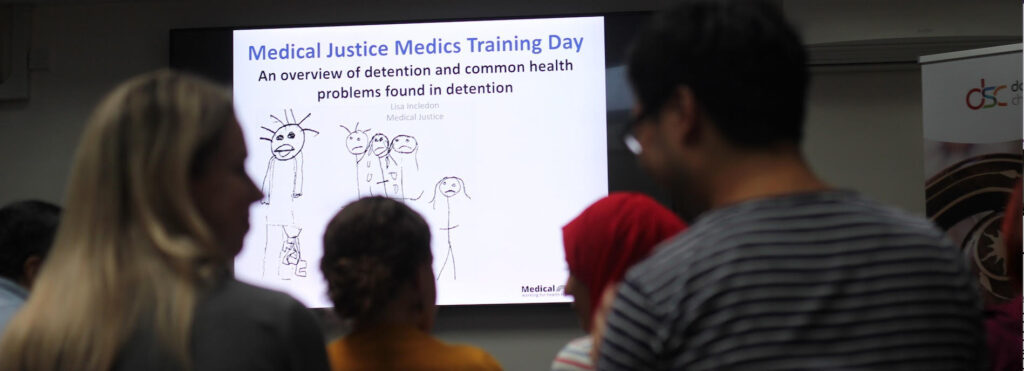
Basic Training Day For Clinicians – October 2023


We are very pleased to announce details of our next Basic Training Day which will take place on Saturday the 28 October 2023. The training day will start from 9.45am and end at 5.30pm.

We are very excited to be able to offer this training in person in Central London. The training day is supported by self-study modules in the assessment of mental health and scarring which we recommend those new to this field complete in advance of the day (approx 4 hours).

Our Basic Training Day is for doctors and psychologists who are interested in volunteering for Medical Justice as medico-legal report writers, visiting detained people in detention centres or conducting remote assessments, assessing their health and documenting clinical evidence of torture and other health issues.

The aim of this course is to gain an understanding of the health and legal needs of asylum seekers and other immigration detainees. The skills learnt will focus on assessing persons detained under immigration powers, as well as medico-legal report writing

The training covers the relevant legal processes, assessing scarring and mental health and report writing skills.

Requirements from Doctors:

  • ST4 or above, or with equivalent clinical experience (i.e. completed 5 years’ post-qualification)
  • Full registration from the GMC with a licence to practice
  • Indemnity insurance
  • Clinical experience at ST1 level or above with adults or adolescents age 16 or over within the last 3 years. This may include clinical experience with adults in non-NHS or overseas settings.

Requirements from Clinical Psychologists:

  • At least two years’ post-doctorate experience (or relevant extensive experience in a specialist refugee or trauma service)
  • Professional registration with the HCPC
  • Indemnity insurance
  • Clinical experience with adults or adolescents age 16 or over within the last 3 years (slightly less recent experience may be acceptable if extensive).


Participation fees

On request, fees are reimbursed after the doctor has written an MLR for a Medical Justice referral


£120 – Consultant/GP

£80 – Trainee doctors (ST4 onwards) and psychologists

Free – Medical Justice volunteer (carried out one detention visit in last 12 months)


Note: please tell us if you would have difficulties paying a fee – we can help.


How to apply

Please follow link below and provide the information requested and we will be in touch once your details have been reviewed by our Clinical Advisors.

If you have any questions, please contact Anthony on a.omar@medicaljustice.org.uk

Submit Registration Details


Medical Justice is a small charity that sends volunteer clinicians into the UK’s 7 IRCs to visit men and women detained arbitrarily and indefinitely. We assist about 1,000 detainees a year, most of whom are asylum seekers, and most are later released. Our volunteer doctors write medico-legal reports (MLRs) documenting the scars and mental health consequences of torture, identify unmet health needs and challenge instances of inadequate healthcare provision. We are the only charitable organisation in the UK that does this. Our training is therefore unique and provided by experienced doctors in the field.

Permission granted in Medical Justice judicial review of the second opinion medical reports policy

Medical Justice have been represented by Wilson Solicitors in a challenge to Home Office guidance providing for the Home Office to seek second opinion medical reports for people in immigration detention. 

At an oral hearing at the Royal Courts of Justice on 25th July 2023, Mrs Justice Heather Williams DBE granted Medical Justice permission to argue its case at a full hearing, to take place later this year. The judge also granted our application for a Costs Capping Order. This means that we will be protected against the risk of adverse costs we cannot afford.  

The case concerns the Home Office’s Adults at Risk policy, which is a key safeguard intended to ensure that the detention of people who are vulnerable to harm in immigration detention is kept to a minimum. The policy was introduced following Stephen Shaw’s review, which found that vulnerable people were being detained too often and for too long.  

Our challenge argues that the second opinion policy is unlawful because it purports to allow the Home Office to disregard a medico-legal report provided by a person in immigration detention while it seeks a second opinion from a Home Office contracted doctor. The process of obtaining a second opinion report can take up to 28 days, with no timescale for the Home Office to consider the report and undertake a detention review. The policy recognises that Home Office caseworkers are not clinically trained; this limits their ability to evaluate rival medical reports. Instead, the policy directs caseworkers to decide vulnerability based upon clinical issues the two doctors agree on. In practice, this will likely mean that vulnerability will be assessed at a lower level than would be the case if the medical report provided by the detainee was assessed on its terms. 

We further argue that the second opinion policy is inconsistent with the Adults at Risk statutory guidance, which states that medical reports which meet certain base line standards should be accepted as the evidence at the highest level of vulnerability (level 3). It also argues the policy frustrates the legislation the statutory guidance is made under (section 59 of the Immigration Act 2016), whose purpose is to minimise the detention of people who are particularly vulnerable to harm in immigration detention. Finally, it is alleged that it was unlawful to introduce the policy without following an established practice of consultation with Medical Justice and other stakeholders. The judge held that all of these grounds are arguable.  

The Illegal Migration Act 2023, which recently received Royal Assent, dramatically expands the government’s immigration detention powers and makes it harder for people to challenge their detention. The Adults at Risk policy will be an even more important safeguard once this legislation is operationalised.  

We are grateful to Jed Pennington and Gabriel Tan at Wilson Solicitors and to our counsel team, Shu Shin Luh and Laura Profumo, of Doughty Street Chambers.  

Medical Justice Annual Report 2022/23

1st February 2022 – 31st January 2023

Download the Annual Report

See the 2022-23 Medical Justice Annual Report for more about what we do to secure lasting change, including:


Rwanda Scheme  – We handled 511 referrals for detained clients, half of them self-referrals. 51 of these people were targeted for deportation to Rwanda. Our advocacy work challenging the Rwanda scheme included:

  • We submitted 2 witness statements for Asylum Aid’s legal challenge of the Rwanda scheme.
  • Our report “Who’s Paying the Price? The Human Cost of the Rwanda Scheme”, based on 36 clients, showing that 26 had indicators of torture histories and 17 of trafficking, 15 had complex mental ill-health, 11 had suicidal thoughts.
  • We organised an All-Party Parliamentary Group briefing session with UNHCR, Medical Justice and Asylum Aid.
  • We provided oral evidence to the Home Affairs Committee and submissions to other parliamentary committees.
  • We helped galvanise medical organisations – British Medical Association said “It would be difficult to exaggerate the mental health impacts of transferring migrants to Rwanda.”


Brook House Inquiry (BHI) video footage revealed how normalised the infliction of pain was, the suffering and humiliation of detained people by immigration removal centre (IRC) guards who showed an underlying lack of any empathy, even when people were at their most vulnerable, even in life-threatening situations.

  • Medical Justice acted as a Core Participantin the Brook House Inquiry. Our submissions were pivotal, demonstrating the causal link between clinical safeguard failures and the widespread abuse being investigated.
  • Our “Harmed Not Heard” report, submitted to BHI, evidenced such failures are ongoing across all IRCs, underlining the urgency, given mass incarceration of asylum seekers called for by the Illegal Immigration Act.
  • 87% of the clients the report was based on had suicidal and/or self-harm thoughts recorded by a Medical Justice clinician at their assessment – all were deprived of a safeguarding report identifying their risk of suicide.


Scaling up – With a generous grant from This Day Foundation via an intermediary, we were able expand our clinical team with with an infectious disease registrar, two experienced GPs and a psychiatrist, lead to more medical assessments and detention visits, more volunteer sign-ups and more clinicians being trained to assess vulnerable people in detention.


At Manston there was chronic overcrowding, thousands of detained people sleeping in cold, wet tents, toilets overflowing with excrement, outbreaks of infectious diseases, death, people forcibly restrained after asking for food. We challenged new legislation allowing safeguards and standards at sites designated as “residential Holding Rooms” like Manston to be dramatically downgraded, whilst quadrupling the length of time that people can be detained there.


The scale of all this rampant cruelty can feel overwhelming, though it also underlines why the small but mighty Medical Justice is needed more than ever.  We will endeavour to reach as many people in detention and quasi-detention as possible, and no doubt our medical evidence will be at the heart of litigation and advocacy work challenging the odious new policies.


We hear daily from the people we work with about the abuse and brutality inherent in immigration detention and the impact it has. We have also seen incredible kindness and courage in the face of the daily hostility of the immigration system with people in detention supporting one another and speaking out about their experiences.


We are incredibly grateful to everyone who has been part of the work this year to oppose detention and to support the people subjected to it.


“I would have died. I was on suicide watch. I wanted to die. If Medical Justice wasn’t there, I would have been in the ground today” – Former client

Joint civil society statement on the passage of the Illegal Migration Act

As a coalition of 290 organisations representing the human rights, migrants’ rights, refugee and asylum, anti-trafficking, children’s, violence against women and girls, LGBTQI+, disability rights, health, LGBTQI+, housing, racial justice, criminal justice, arts, international develop-ment, environment, democracy, pan-equality, faith, access to justice, and other sectors, we condemn the passage of the Illegal Migration Act today, and stand in solidarity with all who will be affected.

We all deserve to live safe from harm. But this senselessly cruel Act will have a devastating impact on people’s lives. It turns our country’s back on people seeking safety, blocking them from protection, support, and justice at a time they need it most.

In abandoning the UK’s moral and legal obligations, the Act risks breaching multiple interna-tional human rights treaties including the Refugee Convention and the European Convention on Human Rights while shielding the Government from accountability. The UK Government has admitted that it cannot confirm if the Act is compatible with the UK’s obligations under the European Convention on Human Rights.

The Act will force people into situations that threaten their lives – whether by placing children in detention or sending people off to countries where their lives might be at grave risk. More-over, the Act attacks the very core of human rights, which is the principle that we all have them regardless of who we are or where we are from. In stripping the most basic rights from people seeking safety and a better life, the Act dismantles human rights protections for all of us.

Either all of us have human rights, or none of us do. While the UK Government’s plans will harm those seeking safety the most, this is an attack on all of us and the values we hold dear.

The government has rushed through this law despite broad and deep opposition. But our fight is not over. As caring people, we will continue to fight for the right for people to seek safety and a better life without being forced to take dangerous journeys and without being punished for how they enter the UK. We will keep holding those in power to account for upholding the UK’s international obligations. We will strive for an asylum and immigration system that treats everyone with dignity and respect. We will stand in solidarity with and fight alongside everyone who makes the UK their home and build a society that treats everyone with compassion.

Signatories
1. Akiko Hart, Interim Director, Liberty
2. Alexandra Loupoukhine, Interim Executive Director, JCWI
3. Sonya Sceats, Chief Executive, Freedom from Torture
4. Joyce Kallevik, Director, WISH
5. Professor Robert Moore, NWREN
6. Eiri Ohtani, Director, Right to Remain
7. Alison Pickup, Director, Asylum Aid
8. Jess McQuail, Director, Just Fair
9. Julie Bishop, Director, Law Centres Network
10. Kyle Taylor, Founder, Fair Vote UK
11. Kerry Smith, CEO, Helen Bamber Foundation
12. Andrea Simon, Director, End Violence Against Women Coalition
13. Traci Kirkland, Head of Charity, Govan Community Project
14. Amber Bauer, CEO, for Refugees
15. Anna Rudd, Interim Director, ASSIST Sheffield
16. Jim McAuliffe, Chair, Lighthouse Relief
17. Robina Qureshi, Positive Action in Housing
18. Kayte Cable and Vicki Felgate, Co-founders, Big Leaf Foundation
19. Siân Summers-Rees, Chief Officer, City of Sanctuary UK
20. Christine Bacon, Co-Artistic Director, Ice and Fire Theatre
21. Mark Goldring, Director, Asylum Welcome
22. Shameem Ahmad, CEO, Public Law Project
23. Marguerite Hunter Blair, CEO, Play Scotland
24. Aderonke Apata, Founder and CEO, African Rainbow Family
25. Sarah Teather, Director, Jesuit Refugee Service UK
26. Amos Schonfield, CEO, Our Second Home
27. Emma Ginn, Director, Medical Justice
28. Mia Hassenson-Gross, Director, René Cassin
29. Katie Fennell, National Coordinator, KIND UK
30. Dr Shabna Begum and Laurence Jay, Interim Co-CEO’s, Runnymede Trust
31. Stephanie Habib, Executive Team, English for Action (EFA) London
32. Anna MacDonald, Co-founder, Play for Progress
33. Dr Helen Taylor, Director, Stories and Supper
34. Anne Fox, CEO, Clinks
35. Liz Fekete, Director, Institute of Race Relations
36. Chris Jones, Director, Statewatch
37. Leila Zadeh, Executive Director, Rainbow Migration
38. Anna Jones, CEO & Co Founder, RefuAid
39. Shoaib M Khan, Partner, SMK Law Solicitors
40. William Gomes, Director, The William Gomes Podcast
41. Alphonsine Kabagabo, Director, Women for Refugee Women
42. Bridget Young, Director, NACCOM (No Accommodation Network)
43. Dr Ruth Allen, Chief Executive, British Association of Social Workers
44. Sebastian Rocca, CEO, Micro Rainbow
45. Anber Raz, Chair of the Board of Trustees, Imkaan
46. Naomi Webb, Executive Director, Good Chance Theatre
47. Zara Mohammed, Secretary-General, Muslim Council of Britain
48. Revd Dr Tessa Henry-Robinson, Moderator of General Assembly, United Reformed Church
49. Trustee, Waltham Forest Migrant Action
50. Rosario Guimba-Stewart, CEO, Lewisham Refugee and Migrant Network (LRMN)
51. Mel Steel, Director, Voices in Exile
52. Lis Murphy, Creative Director, Music Action International
53. Mariko Hayashi, Executive Director, Southeast and East Asian Centre (SEEAC)
54. Zrinka Bralo, CEO, Migrants Organise
55. Fizza Qureshi, CEO, Migrants’ Rights Network
56. Robbie de Santos, Director of External Affairs, Stonewall
57. Sally Daghlian OBE, CEO, Praxis
58. Emily Crowley, Chief Executive, Student Action for Refugees (STAR)
59. Peter Marsden, CEO, Concordis International
60. Lara Parizotto & Alex Bulat, Co-Directors, Migrant Democracy Project
61. Tim Naor Hilton, Chief Executive, Refugee Action
62. Sacha Deshmukh, Chief Executive, Amnesty International UK
63. Anthea Sully, Chief Executive, White Ribbon UK
64. Souad Talsi MBE, Founder and Interim CEO, Al-Hasaniya Moroccan Women’s Project Ltd
65. Hugh Russell, Chief Executive, Children in Wales – Plant Yng Nghymru
66. Comfort Etim, Director, Refugee Women Connect
67. James Wilson, Director, Detention Action
68. Revd Gill Newton, President of the Methodist Conference
69. Joanne MacInnes, West London Welcome
70. Kerry Scarlett, Vice-President of the Methodist Conference
71. Natasha Eeles, CEO & Founder, Bold Voices
72. Dianna Nammi, Executive Director, IKWRO
73. Alison, JURIES
74. Christine Allen, Director, CAFOD
75. Catharine Walston, Chair of Core Committee, Cambridge Refugee Resettlement Cam-paign
76. Marissa Green, Chair of Trustees, Cambridge Convoy Refugee Action Group
77. Jayne Butler, CEO, Rape Crisis England and Wales
78. Marchu Belete & Sarah Cutler, Co-directors, Migration Exchange
79. Aké Achi, Founding Chief Executive, Migrants At Work
80. Aké Achi, CEO, Black Europeans
81. Shaminder Ubhi, Director, Ashiana Network
82. Yasmine Ahmed, UK Director, Human Rights Watch
83. Angie Herrera, Director, Latin American Women’s Aid (LAWA)
84. Harriet Wistrich, Director, Centre for Women’s Justice
85. Iona Taylor, Advocacy and Campaigns Lead, Positive Action in Housing
86. Emma Hutton, CEO, JustRight Scotland
87. Nick Watts, Director, Together with Migrant Children
88. Ruth Davison, CEO, Refuge
89. Mollin Delve, CEO, PHOEBE
90. Enver Solomon, CEO, Refugee Council
91. Sabrina Qureshi, Founder and Coordinator, Million Women Rise Movement
92. Jo Cobley, CEO, Young Roots
93. Laura Tomson and Rachel Adamson, Co-Directors, Zero Tolerance
94. Steven Smith, CEO, Care4Calais
95. Kathy Evans, Chief Executive, Children England
96. Indy Cross, Chief Executive Officer, Agenda Alliance
97. Shari Brown, Partnership and Development Manager, Refugee and Migrant Centre (West Midlands)
98. Kate Roberts, Head of Policy, FLEX
99. Selma Taha, Executive Director, Southall Black Sisters
100. Estelle Du Boulay, Director, Rights of Women
101. Rita Gava, Kalayaan
102. Natalie Collins, CEO, Own My Life
103. Jason Thomas-Fournillier, Senior Administrator, Spectrum Rainbow Community
104. Gisela Valle, Director, LAWRS
105. Catherine Gladwell, Chief Executive, Refugee Education UK
106. Barbara Drozdowicz, CEO, East European Resource Centre
107. Lucy Nabijou, Coordinator, Haringey Welcome
108. Dr David Brown, Chair, Birmingham City of Sanctuary
109. Josie Naughton, CEO, Choose Love
110. Danielle Roberts, Senior Policy and Development Officer, Here NI
111. Khedijah Mohammed-Nur, Cofounder, Network of Eritrean Women-UK
112. Rupert Skilbeck, Director, REDRESS
113. Sophie Neuburg, Director, Medact
114. Sharon Erdman, CEO, RASASC
115. Ghadah Alnasseri, Head of Policy and Public Affairs, Hibiscus Initiatives
116. Maddy Crowther, Co-Executive Director, Waging Peace
117. Laura Kyrke-Smith, Executive Director, International Rescue Committee UK
118. Eleanor Brown, CEO, CARAS
119. Jane Lees, CEO, Communityworks
120. Jo Benefield, Campaign Coordinator, Bristol Defend the Asylum Seekers Campaign
121. Nicola David, Founder, One Life to Live
122. Chris Rose, Chair, Craven District of Sanctuary
123. Ben Gilchrist, Chief Executive, Caritas Shrewsbury
124. Skipton Refugee Support Group
125. Ailsa Dunn Secretary to Hay, Brecon and Talgarth Sanctuary for refugees
126. Revd Canon Helen Cameron, Moderator, Free Churches Group
127. Zita Holbourne, BARAC UK
128. Angie Pedley, Treasurer, Settle Area Refugee Support
129. Rosie MacPherson, Artistic Director and Joint CEO, Stand and Be Counted Theatre
130. Dr Nicola Sharp-Jeffs OBE, CEO, Surviving Economic Abuse
131. Astrid Laich, Secretary, Bournville Amnesty
132. Kush Chottera, CEO, Europia
133. Jeremy Thompson, Manager, Restore – a project of Birmingham Churches Together
134. Anna Pincus, Director, Gatwick Detainees Welfare Group
135. Tess Berry-Hart, Director, Citizens of the World Choir
136. Georgina Fletcher, Chief Executive, Regional Refugee Forum North East
137. Zlakha Ahmed, Chief Executive, Apna Haq
138. Refugee and Migrant Partner Lead, Sector 3
139. Mike Wild, Chief Executive, Macc
140. Christopher Desira, Director, Seraphus
141. Amanda Church-Mcfarlane, Co-CEO, Abigail Housing
142. Professor Jenny Phillimore, Institute for Research into Superdiversity, University of Birmingham
143. Revd. Ian Rutherford, City Centre Minister, Methodist Central Hall Manchester
144. District Ecumenical Officer, Greater Manchester Churches Together
145. Paul Parker, Recording Clerk, Quakers in Britain
146. Martin Drewry, CEO, Health Poverty Action
147. Mick Taylor, Project Coordinator, Support for Wigan Arrivals Project
148. Gail Heath, CEO, Pankhurst Trust
149. Miranda Reilly, Director, AVID
150. Hayley Nelson BEM, Director, Learn for Life Enterprise
151. Vivienne Hayes, CEO, WRC
152. Vicar, St Paul’s Church
153. Richy Thompson, Director of Public Affairs and Policy, Humanists UK
154. Jan Foster, Trustee, Doncaster Conversation Club
155. Jo Todd, CEO, Respect
156. Jamie Balfour-Paul, Founder and Performing Magician, Magic for Smiles
157. Sarah Lange, Lead Coordinator, Wyre Forest Supports Asylum Seekers
158. Catherine Mackle, Director, Community Welcome cic
159. Angus Clark, Chief Executive – Herts for Refugees
160. Phil Kerton, Co-Director, Seeking Sanctuary
161. Lisa-Marie Taylor, CEO, FiLiA
162. Warren Elf MBE, Co-Chair, Faith Network for Manchester
163. Sara Alsherif, Migrant Digital Justice Programme Manager, Open Rights group
164. Charlie Zosseder, Director, Samphire
165. Martin Cosarinsky Campos, Managing Director, Breadwinners
166. Tom Cheesman, Trustee, Swansea Asylum Seekers Support
167. Sanchita Hosali, CEO, British Institute of Human Rights
168. Nathan D Ndlovu, Chairman, CARAG
169. Kevin Hanratty, Director, Northern Ireland Human Rights Consortium
170. Ian Hodson, National President, BFAWU
171. Mauricio Silva – Inter-Religious Coordinator, Columbans in Britain
172. Bishop Mike Royal, General Secretary, Churches Together in England
173. Joan Hoult, CEO, Walking With in North Tyneside
174. Johannah Dyer, Chair, Bromsgrove and District Asylum Seeker Support
175. Patrick O’Dowd, Director, Caritas Diocese of Salford
176. Dr Pat Bond, Chair, New to the UK, North Shields
177. Barbara Hungin, Chair of Trustees, Justice First
178. Programme Development Director, Railway Children
179. Jabbar Hasan, Director, Iraqi Association
180. Paul Hook, Director, Asylum Matters
181. Revd Jide Macaulay, Founder & CEO House of Rainbow CIC
182. Stephanie Neville, Project Manager
183. Dr Ruvi Ziegler, Chair, New Europeans UK
184. Robert Hooper, Pastor, Oasis church
185. Abigail Martin, Manager, St Chad’s Sanctuary
186. Darren Knight, Chief Executive, George House Trust
187. Toni Soni, Centre Director, Coventry Refugee and Migrant Centre
188. Imogen McIntosh, Aid Box Community
189. Victoria Marks, Director, Anti Trafficking and Labour Exploitation Unit (ATLEU)
190. Manuchehr Maleki, Co-Chair, SYMAAG
191. Stuart Crosthwaite, Secretary, SYMAAG
192. The Revd Steve Faber, Moderator, URC West Midlands Synod
193. Misak Ohanian, CEO, Centre for Armenian Information and Advice
194. Stan Beneš, Managing Director, Opora
195. M Fahim, Manager, Afghan community and welfare centre
196. Dr Paul Martin OBE, LGBT Foundation
197. Nazee Akbari, CEO, New Citizens’ Gateway
198. Rebecca Stevenson – Read – Centre Manager, St Vincent’s Centre Newcastle upon Tyne
199. Zoe Gardner, National Committee, Another Europe is Possible
200. Nicholas Prescott, Project Manager, Fallowfield & Withington Foodbank
201. Seana Roberts, Manager, Merseyside Refugee Support Network
202. Seana Roberts, Administrator, Liverpool City of Sanctuary
203. Rabbi Warren Elf MBE, Rabbi, Southend and District Reform Synagogue
204. Ros Holland, Chief Exec, Boaz Trust
205. Nick Beales, RAMFEL
206. Lara Bundock, CEO, Snowdrop Project
207. Andrea Cleaver, CEO, Welsh Refugee Council
208. Ailsa MacKenzie, Chief Officer, The Pyramid at Anderston
209. Rachel Wing, Treasurer/Co Ordinator, Refugee and Asylum Seeker Project, Stockton on Tees
210. David Weaver, Chair, Operation Black Vote
211. Lee Jasper, Co-founder, Blaksox
212. Efi Stathopoulou, Programmes Manager, Refugee Legal Support
213. Vicar, St Paul’s Church Birmingham
214. Kat Lorenz, Director, Asylum Support Appeals Project
215. Denise McDowell, CEO, Greater Manchester Immigration Aid Unit
216. Elham Kashefi, Tara Centre
217. Maria Brul, Policy and Public Affairs Manager, Children and Families Across Borders
218. Katie Morrison, CEO, Safe Passage
219. Nazek Ramadan, Migrant Voice, Director
220. Daniel Sohege, Director, Stand For All
221. Stephanie Draper, Chief Executive, Bond
222. Revd Kate Gray, The United Reformed Church, Wythenshawe
223. Paddy Kelly, Director, Children’s Law Centre
224. Clare Moody, Joint CEO, Equally Ours
225. Sampson Low, Head of Policy, UNISON
226. Frank Parnham, Secretary, Barnsley Borough City of Sanctuary
227. Salma Ravat, CEO, One Roof Leicester
228. Dr Sarah Hughes, Chief Executive, Mind
229. Yvonne Rendell, Chair, Bromsgrove and Redditch Welcome Refugees
230. Karen Parry, Chief Executive, Inclusion North
231. Christine Rose Chair of the Core Group,Craven District of Sanctuary
232. Beatrice Giaquinto, Director, Nottingham Arimathea Trust
233. Gwen Hines, Chief Executive, Save the Children
234. Jennifer Nadel and Matt Hawkins, Co-Directors, Compassion in Politics
235. Andrew Belfield, Mosaic Justice Network
236. Kamran Mallick, CEO, Disability Rights UK
237. Liz Millman, North Wales Jamaica Society
238. Liz Millman, Learning Links International CIC
239. Garrick Prayogg project Manager, Cultural Diversity Network
240. Rev. Dr. Joseph D Cortis coordinator of Caritas Leeds
241. Zoe Bantleman, Legal Director, Immigration Law Practitioners’ Association (ILPA)
242. CEO, Cast – Communities and Sanctuary Seekers Together
243. Jane Grimshaw, Convener, Hastings Supports Refugees
244. Sarah Hayes, Vicar, St Germains Church Birmingham
245. Polly Gifford, Co-Chair, Hastings Community of Sanctuary
246. Ernie Whalley, Chair, Reach group, New North Road Baptist Church, Huddersfield
247. Mojgan Bakhtiary, Development Manager, Taban
248. Louise King, Director, Children’s Rights Alliance for England
249. Alison Page, Chief Executive, Salford CVS
250. Jo Walby, Chief Executive Officer, Salford CVS
251. Aleema Shivji, Chief Impact Officer, Oxfam GB
252. Gill Kelly, Chair, Wolverhampton City of Sanctuary
253. Rose Caldwell, CEO, Plan International UK
254. Frank Forman, Nottingham and Nottinghamshire Refugee Forum
255. Alex, General Advice Coordinator, Manchester Refugee Support Network
256. Revd Sarah Jemison (Chair of Trustees), BEACON (Bradford Ecumenical Asylum Con-cern)
257. Pauline Mary Ruth. Chair of Trustees. Trinity Safe Space Charity
258. Abi Brunswick, Director, Project 17
259. Dr Arabella Hamilton, Lay Chair of the Parochial Church Council
260. Sian Summers-Rees, Chief Officer, City of Sanctuary UK
261. Amy Lythgoe, Trustee, Together Now
262. Miriam Turner and Hugh Knowles, Co-Executive Directors, Friends of the Earth (Eng-land, Wales and Northern Ireland)
263. Mark Russell, CEO, The Children’s Society
264. Humma Nizami, Executive Director, Race Equality Network
265. Jonathan Senker, CEO, VoiceAbility
266. Joanna Ewart-James, Executive Director, Freedom United
267. Michael Mark, Trustee, The Cotton Tree Trust
268. Areeba Hamid, Co-Executive Director, Greenpeace UK
269. Andreea Dumitrache, Interim Co-CEO, the3million
270. Stephanie Grimshaw, Head of Public Affairs and Policy, Welsh Women’s Aid
271. Saqib Deshmukh, Interim Chief Executive, AYJ
272. Joseph Kiwango, Manager, Revive
273. Tufail Hussain, UK Director, Islamic Relief
274. Eleni Venaki, Director, The Comfrey Project
275. Amanda Littlewood, Refugees & Mentors CIC
276. Sabir Zazai, Chief Executive, Scottish Refugee Council
277. Úna Boyd, Committee on the Administration of Justice
278. Eleonora Fais, Anti-Trafficking Monitoring Group Coordinator, ATMG
279. Rev Lynn Green, General Secretary, Baptist Union of Great Britain
280. Emma Hawthorne, Chair, BIRCH
281. Simon Tyler, Executive Director, Doctors of the World UK
282. Laura, Director, Horton Community Farm
283. Phil Davis, Director, Hope Projects
284. Sally Hyman, founder and CEO, CRIBS International
285. Mark Courtice (Chair), Southampton and Winchester Visitors Group
286. Dr Patrick Roach, General Secretary, NASUWT Teachers’ Union
287. Trustee, Louth Churches for Refugees
288. Jessica Davidson-Egan, Director, Refugee Welcome Homes
289. Andrew Evans, CEO, METRO Charitye
290. Nick Harborne, CEO, Refugee Support Group


See the joint statement here

CANCELLED | Coming together to challenge the medical harm of mass refugee incarceration

EVENT CANCELLED

We have had to cancel the 27th July Medical Justice annual meeting event “Coming together to challenge mass refugee incarceration” at Garden Court Chambers – there is a tube strike planned for that day.


Speakers

British Medical Association | Dr Kitty Mohan, Chair of the BMA’s International Committee
Medical Justice | Bridget Banda, vice-chair; Dr Rachel Bingham, Clinical Advisor
Garden Court Chambers | Stephanie Harrison KC
All Party Parliamentary Group on Immigration Detention | TBC


As 46 asylum seekers were placed in quasi-detention on Wednesday 12/07/2023 at Wethersfield military site after small boat crossings, and we witness the government planning to inflict grave harm – knowingly – to vulnerable people through the provisions of its Illegal Migration Bill, there hasn’t been a more important time in recent history to stand together and challenge the abuse of indefinite immigration detention, in all its forms. 

With valiant efforts to curtail the Bill still ongoing, we invite you to join us in turning attention to challenging whatever unjust legislation gets enacted together.  We will be celebrating and building on the remarkable collaboration around the Bill that has been taking place between parliamentarians, lawyers, medical organisations, human rights advocates, funders, journalists and those with lived experience of immigration detention … all of whom we are inviting to come together. 

You, your colleagues, friends and family are warmly invited to come and share thoughts – we will be strategising, creating synergy, and preparing to amplify each others’ efforts. 


Itinerary

6pm – Welcome
6.30pm – Speeches & Q&A
7.30pm – Drinks, Finger-food, networking
9pm – Close


Please book places – by emailing info@medicaljustice.org.uk 

Travel costs reimbursed – within London, for those without the right to work or claim benefits.

Vacancy: Caseworker / Trainee Caseworker

We are no longer taking applications


Would you like to work as a Caseworker for Medical Justice assisting people in immigration detention?

We particularly welcome applications from people with lived experience – see the Application Pack for details.

Come and work with Medical Justice, a small and dynamic team that builds on casework to produce research that is used to challenge systemic failures in healthcare provision in immigration detention. We expose medical mistreatment in detention and strive for lasting change for all detained people through policy work, strategic litigation, media coverage and parliamentary action.


“Joining Medical Justice as a Caseworker has been a great experience right from the beginning. The team at Medical Justice are very supportive, knowledgeable, and passionate about the work that they do, it has been a great environment to work in. I found the role to be very rewarding; you get to make a real difference in the lives of those that are vulnerable during some of the most difficult times they are experiencing.

The support I received from the Experts by Experience Employment Initiative was really helpful in applying to and joining this role. They offer support from the beginning stages of applying to support once you join the role e.g., CV/cover letter advice, interview preparation, and onboarding support. I found the advice to be thorough and detailed, the mentor I had was very communicative and supported me throughout the different stages of the application.”

Lujain, Medical Justice caseworker


Job Purpose: Ensure Medical Justice assists as many people in detention as it can and as well as it can, to access adequate healthcare and obtain high-quality independent medical evidence to progress their legal case.

Salary: Depending on experience – £27,395 (Trainee Caseworker) to £30,197 (Caseworker) with an annual increase of £500 for 5 years and cost of living increases (when relevant) three times a year.

Trainee position: This is not linked to a formal training programme. It will normally be expected that the Caseworker Trainee will progress to Caseworker after 2 years – the salary and level of responsibility will increase, whilst the level of supervision will decrease.

Reports to: Casework Manager

Working hours: Full-time

Based: Medical Justice office with some flexibility for working from home after an initial period

Length of contract: 2 years, with renewal if funding available

Terms: 28 days annual leave per annum plus statutory bank holidays

Timeline: The closing date for applications is Wednesday 26th July 2023. Interviews will take place on Tuesday 1st and Friday 11th August 2023 at the Medical Justice office and will include a written and verbal exercise. The ideal timeframe for starting the job is as soon as possible

To apply: Please read the Application Pack which includes the Job Description and the application form. Email your competed application form and your CV to Anthony at a.omar@medicaljustice.org.uk


We look forward to receiving your application !