Skip to content

Author: anthony

Annual Report | Financial Year February 2024 – January 2025

Read the Annual Report here


The Medical Justice Financial Year ending 31st January 2025 Annual Report shows how we changed lives and made detention less harmful. Thank you for making it possible. You can download the report here.

In 2024, inspectors warned of the worst conditions they have ever found in immigration removal centres (IRCs) where detained people continue to be at imminent risk.

20,604 men, women and children were held in detention in 2024. The situation remains urgent – this report details how Medical Justice continues to evidence the severe harm caused to detained clients by the catastrophic failures in safeguards that have led to inhuman and degrading treatment.

In 2024, rather than change direction and strengthen safeguards, the new Labour government continued the previous government’s moves to weaken safeguards and to expand detention, in full knowledge of the severe harm this risks – harm that cannot be described as accidental.

Changing lives

  • 508 referrals for detained people in 2024 – some say we changed the course of their lives.
  • 90% of a set of 73 clients assessed by Medical Justice clinicians and received a medio-legal report were released.

Secured systemic lasting change making detention less harmful for thousands of people

  • Released: research report “You’ll see the outside when you’re in Rwanda” – analysis of harm caused to 48 clients detained for removal to Rwanda. 82% were torture survivors. 78% had suicidal thoughts. All 48 were released.
  • Established: duty to consult Medical Justice on detention policies affecting vulnerable people – our successful litigation means the Home Office must engage constructively with us, and receive our evidence and suggestions for improvements, which, if adopted, potentially benefit thousands of detained people.
  • Secured: improvements to clinical safeguards for thousands of detained people each year – including Home Office Rule 35 training for IRC clinicians, NHS England guidance on Rule 35 safeguarding reports and Adults at Risk Statutory Guidance.
  • Galvanised: Medical Justice evidence quoted by the Royal College of Psychiatrists – our research, analysis and case-studies used in the report “Protecting the mental health of people seeking sanctuary in the UK’s evolving legislative landscape”, covered by the British Medical Journal and galvanising the medical community.


Clearly these achievements in FY2025 are stepping stones. Our ultimate vision is that immigration detention is unable to harm anybody’s physical or mental health as it no longer exists in the UK. Certainly, this is a long-term endeavour, and it cannot come about without the stepping stones we are laying down now.

One of the most significant systems changes to make the immigration and asylum system more humane is to end the mistreatment of people held indefinitely in immigration detention. That is unlikely to happen without medical evidence of the harm. Medical Justice is the only source of such medical evidence as it is the only charity to send clinicians to see detained people in all the UK’s IRCs, to document the harm they suffer, to analyse and to present the evidence in a digested format to use in our own advocacy work for system change and by like-minded groups. Medical Justice is recognised as the UK’s expert on deterioration of detained people’s health, with extensive and uncontested evidence of how and why dysfunctional clinical safeguards severely harm detained people.

Medical Justice is a critical actor in the required collaboration of organisations and voices. In 2024, we galvanised the influential voice of the medical community and primed parliamentarians to act by bringing them together with experts, lawyers, detention monitoring bodies, and people with lived experience through the All-Party Parliamentary Group (APPG) on Immigration Detention for which we act as the secretariat.

We thank all our partners, clients and funders for their invaluable support.

Supreme Court favourable decision in Medical Justice’s judicial review

Medical Justice welcomes the Supreme Court’s decision to refuse the Home Office permission to appeal a ruling that its failure to consult with Medical Justice on changes to guidance for immigration detention caseworkers was unlawful.


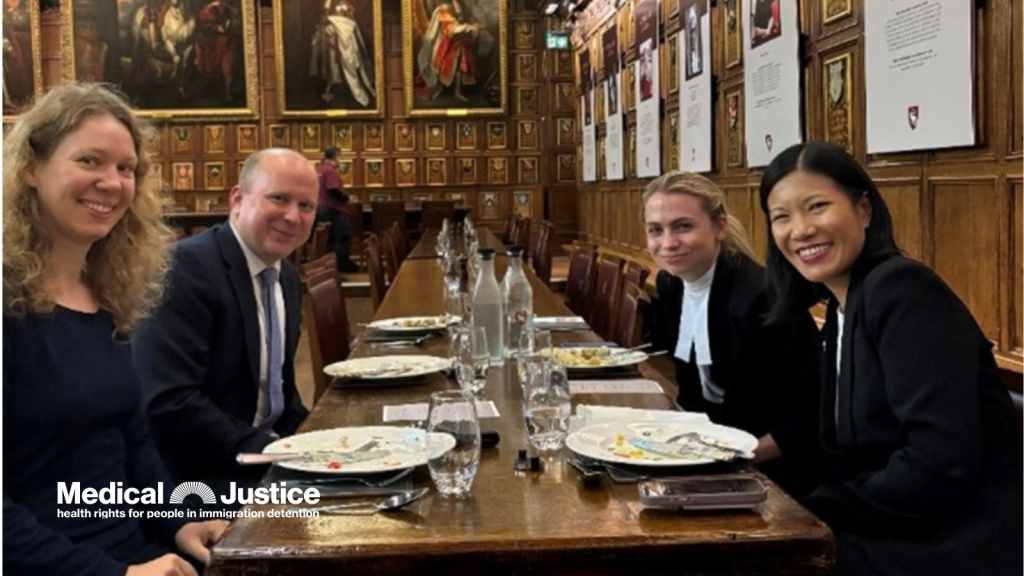
Team having lunch in Middle Temple Hall after the Court of Appeal hearing. From left to right Theresa Schleicher (Medical Justice), Jed Pennington (Wilsons Solicitors), Laura Profumo and Shu Shin Luh


Our judicial review challenged the Home Office’s ‘Second Opinion’ policy which allows it to disregard a medico-legal report from Medical Justice for a detained client while it seeks a second opinion from a doctor it contracts.  There is no requirement for the Home Office doctor to ever actually meet the detained person or have any expertise in documenting deterioration of health in detention. In one case a second opinion report took weeks to be produced, during which time a detained person could deteriorate further in detention.

In January 2024 the High Court found that there had been an unlawful failure by the Home Office to consult Medical Justice regarding changes to its Adults at Risk Caseworker Guidance which lays out the Second Opinion policy. The Home Office appealed and in March 2025 the Court of Appeal upheld the High Court’s decision. The Home Office sought to appeal to the Supreme Court which was refused permission on 4th July 2025.

In most cases, the Home Office does consult NGOs on immigration detention policies, and when it does, Medical Justice has sometimes been able to secure improvements to policies, making them less harmful for thousands of detained people. The Home Office failed to consult on the Second Opinion policy (other than with their own contractors) and that closed the door to the possibility of improvements before it started having an impact on detained people.

This is an important victory for Medical Justice – we want to work constructively with the Home Office to improve policies for people held in detention, and for the Home Office to pay full attention to our expert evidence and analysis based on our clinical assessments of those who have already been severely harmed by its policies.

The courts, inquiries and inspection bodies have repeatedly found that vulnerable people have been subjected to inhuman and degrading treatment in UK immigration detention. The Home Office should be welcoming our input, not shutting the door on policy consultation.

Now the Home Office must consult us on its Adults at Risk policy, the door to policy improvements is permanently wedged open, potentially benefitting many thousands of detained people. Our lawyer said

“I am not aware of another NGO succeeding in a judicial review in establishing a duty to consult … certainly in the context of the immigration system. It is at least very rare, if not unique.”

We thank our very able lawyers – Jed Pennington at Wilsons who instructed Shu Shin Luh and Laura Profumo, who were led in the Court of Appeal and Supreme Court by Angus McCullough KC.

London Legal Walk 2025 | Medical Justice

This year we are celebrating our 20th anniversary and will be walking 10km on Tuesday 17th June to help raise funds for Medical Justice!

Medical Justice is the only charity in the UK to send independent volunteer clinicians to visit people held in Immigration Removal Centres across the UK and document their scars of torture and serious medical conditions.

Evidence from our casework is the platform for our research into systemic failures in healthcare provision, the harm caused by these shortcomings, as well as the toxic effect of immigration detention itself on the health of people in detention. We use our research, policy work, strategic litigation and parliamentary work to secure lasting change.

Please sponsor our walkers as generously as you are able.

You can sponsor us here

£50 could cover the train fare for a volunteer clinician to visit a person in detention to carry out a medical assessment.  

Thank you for supporting our team in fundraising for the 2025 London Legal Walk.


Join the walk

As well as donating you can join us on the 10km walk on Tuesday 17th June to raise funds for Medical Justice. The Medical Justice team will include staff, trustees, former detained people, volunteer clinicians, interpreters, supporters, and others who want to end the injustice suffered by people detained under immigration powers. Children and dogs are also welcome!

London Legal Support Trust: London Legal Walk 2025

Email Ariel at a.plotkin@medicaljustice.org.uk if you want to walk with us, or for more details on logistics.


Law firms who already have a London Legal Walk team can designate funds to Medical Justice

The London Legal Support Trust allow you to designate up to 50% of the funds you raise to a specific agency (or agencies) if you have a significant partnership with the agency.  This can include on-going pro bono support for Medical Justice.  Please email Elspeth at e.macdonald@medicaljustice.org.uk  if your law firm would like to donate money raised to Medical Justice


Any questions?

Email Ariel (a.plotkin@medicaljustice.org.uk) or Elspeth (e.macdonald@medicaljustice.org.uk) or call us on 0204 551 1280.

To set up a monthly donation to Medical Justice click here.

Vacancy | Head of Operations

WE ARE NO LONGER ACCEPTING APPLICATIONS

See our Vacancies page for all current job opportunities

Please sign up to our mailing list to stay up to date with any future job opportunities

JOIN OUR MAILING LIST


Seeking a strategic thinker with strong operational management experience who is absolutely passionate about challenging injustice to strengthen our vibrant and highly respected organisation.

As the first Head of Operations, you will provide strategic oversight, work with staff to translate our strategy into actionable, measurable plans for efficient and effective work, which will enhance the impact for people in immigration detention.  Your management of the team’s operations will support our growth, resilience, and sustainability.

Download the Application Pack.


Head of Operations

Salary: £39,000 to £42,000  with an annual increase of £500 each year for 5 years and 5% pension contribution

Reports to: The Director

Working hours: Full-time. Flexible work patterns can be considered

Where based: At the Medical Justice office near Finsbury Park, London with some flexibility for remote working

Length of contract: Permanent

Terms: 28 days per annum holiday, plus statutory bank holidays, plus 2 Wellbeing days

Benefits: Include ; sick pay from day one, enhanced parental leave, one-to-one counselling sessions and group reflective sessions with a psychologist, ‘cycle to work scheme’, weekly staff lunch, flexible working


What they say about Medical Justice;

“What Medical Justice did was absolutely remarkable. They sent two specialists to see me in Harmondsworth and they did the most amazingly thorough job documenting all my scars. Then I got my medico-legal report which was over 40 pages long. They did thorough, professional work – there is nothing more that they could have done and ultimately this work got me out of detention.” – former detained person and Medical Justice client

“[Medical Justice] has strong characteristics and a highly respected reputation. It is regarded as principled, expert and evidence-based, tenacious in its casework and policy work, fierce and ferocious when needed and brave in the way it speaks truth to power.” – fellow non-governmental organisation

“Medical Justice has an outsized impact for its size – it is highly effective and the team is absolutely terrific, which is all the more impressive in the difficult political context.” – Medical Justice funder


Informal online information sessions

Additional information session this Friday 13th June 1-2pm

An opportunity to ask questions about Medical Justice and its work as well as about the Head of Operations role. Please email Lisa Incledon on l.incledon@medicaljustice.org.uk if you would like to participate in an information session.

Closing date

9am Wednesday 18th June 2025

Further information

Please see the APPLICATION PACK.

Border Security, Asylum and Immigration Bill 2025 – Medical Justice’s work so far

Introduced in January 2025, the government’s new Border Security, Asylum and Immigration Bill includes a number of provisions relating to immigration detention. While some bring positive change, including full repeal of the deeply damaging Safety of Rwanda Act 2024, others are extremely worrying.  

Concerning gaps and changes 

The Bill scraps much of the Illegal Migration Act (IMA) 2023. However, it fails to repeal a number of the Act’s key provisions.  These include Section 12 IMA, which seeks to overturn the long-standing position in caselaw that it is for the courts to determine what constitutes a “reasonable” length of detention, and grant this power instead to the Home Secretary. Section 12 also seeks to enable the Home Secretary to continue detaining a person after the reason for their detention (pending examination, removal, or deportation order/decision being made within a reasonable period of time) has fallen away. The government’s decision to retain these and other provisions in the IMA is very concerning.  

The Bill also fails to repeal damaging provisions in the Nationality and Borders Act 2022. This includes provisions that could introduce unfairly rushed legal procedures for people in detention, such as the accelerated detained appeals process, and priority removal notices. 

Other provisions in the Bill also expand the Home Secretary’s powers to detain people in certain circumstances pending their deportation. This change will also apply retrospectively, raising additional issues in terms of the rule of law. 

What is Medical Justice calling for? 

In light of the concerns above, Medical Justice is calling on MPs and Peers to amend the Bill. The changes we want to see include: 

  • Repeal of the Illegal Migration Act 2023 (IMA) in full to prevent the retention of harmful provisions 
  • Repeal of concerning provisions of the Nationality and Borders Act 2022 (NABA) 
  • Removal of the retrospective effect of detention powers 
  • Introduction of a 28-day statutory time limit on detention, accompanied by judicial oversight of the decision to detain and ongoing detention. 

Parliamentary briefings and evidence  

We have shared our concerns and calls for change in a number of parliamentary briefings and written evidence submissions so far. You can access these in full below.  

Commons Committee Stage (27 Feb – 18 Mar) 

Commons Report Stage / Third Reading (date tbc) 

  • Joint briefing by The Coalition for Asylum Rights and Justice (CARJ), including Medical Justice 

 Joint Committee on Human Rights – legislative scrutiny of the Bill 

  • Joint evidence by Medical Justice and Bail for Immigration Detainees 

Looking ahead 

The Bill is expected to finish its remaining Commons stages shortly after Easter, and will then move into the House of Lords. Further timings are still to be confirmed, but it is possible the legislation may be passed and enacted by the summer.  

Medical Justice will continue to raise concerns about the damaging effects and gaps of the Bill as it makes its way through Parliament, and will share further updates on our work as it becomes available.  

Induction Training Day For Interpreters – April 2025

Our Induction Training Day is for new volunteer interpreters who are joining Medical Justice. By joining Medical Justice as a volunteer interpreter, you can have a positive impact on the lives and health of a vulnerable group of people in the UK. Our interpreters help people in detention seek support and advice despite the language barriers and provide crucial interpretation for medical assessments with our volunteer clinicians.

Volunteers can make a difference by donating time remotely by phone/video or by attending immigration detention centres in person to provide skilled and accurate interpretation. You can volunteer your time flexibly and taken on interpreting at the times that are most suited to you.

The training contains sessions on working with medical professionals as well as an introduction to immigration detention, visiting an IRC and interpreting in a mental health context. We also have ongoing opportunities for feedback and support for volunteers.

This training day will be taking place in person near our offices in Finsbury Park, London.


How to join

If you are interested in joining our interpreter team, please contact Lisa at interpreting@medicaljustice.org.uk for an application form. If you are unable to attend in person, please let us know.


Medical Justice is a small charity that sends volunteer doctors (and other health professionals) into the UK’s 7 IRCs to visit men and women detained arbitrarily and indefinitely. We assist about 1,000 detained people a year, most of whom are asylum seekers, and most are later released. Our volunteer doctors write medico-legal reports (MLRs) documenting scars of torture and challenge instances of inadequate healthcare provision, including denial of medication and access to hospital. We are the only charitable organisation in the UK that does this.


Court of Appeal: Home Office failure to consult Medical Justice unlawful

Medical Justice establishes the right to be consulted by the Home Office on its ‘Adults at Risk’ policies.

The Court of Appeal has upheld a successful judicial review brought by Medical Justice that – based on its consistent practice of consultation – the Home Office has a duty to consult Medical Justice before introducing policy relating to the immigration detention of ‘adults at risk’.

A Medical Justice spokesperson said : “This is a vital curb on the Home Office bringing in ever more injurious detention policies that cause severe harm to those it detains indefinitely.

Over the years there have been some important modifications to Home Office policy following consultation with Medical Justice, resulting in lessening the harmfulness of some policies – that door must not be closed off.  We are delighted that the duty to consult Medical Justice has been established – it is a momentous win in the fight for the rights of people held in immigration detention ; the door to policy improvements is now wedged open.

This constraint on the Home Office has never been more needed ; the Brook House Inquiry revealed an alarming and continuing level of inhuman and degrading conditions in immigration detention and the Home Office has since weakened rather than strengthened safeguards designed to protect vulnerable people in detention. Furthermore,  despite knowing the severe harmfulness, the government has announced a significant expansion of detention, meaning the harm cannot be described as accidental.”

Medical Justice is extremely grateful for skilled representation by Wilson Solicitors partner Jed Pennington, Angus McCullough KC (1 Crown Office Row), and Shu Shin Luh and Laura Profumo (Doughty Street Chambers).

For more details about the case, please see the below, based on a note kindly written by Medical Justice’s legal team.


In a decision handed down on 14th March 2025, the Court of Appeal has upheld a judicial review brought by Medical Justice that the Home Office is required to consult it before introducing any policy affecting the immigration detention of ‘adults at risk’. The Home Office acted unlawfully in failing to do so in respect of a policy which allowed for second medical opinions to be sought from Home Office contracted doctors when presented with medico-legal reports commissioned by or on behalf of people in immigration detention (‘the Second Opinion policy’). The Court of Appeal’s judgment (available here) confirms the importance of the consultation duty as a cornerstone of democratic governance, particularly in the context of the exercise of immigration detention powers.

Background and what the Court of Appeal decided

For more background about the case, you can read the Wilsons Solicitors’ post on the High Court judgment here.

In summary, the High Court’s 12 January 2024 judgment found that the Home Office had a duty to consult Medical Justice, a key stakeholder, on policies affecting the detention under immigration powers of vulnerable people, and that the Home Secretary acted in breach of that important duty by failing to do so during the formulation of and prior to implementation of the Second Opinion policy. The High Court also quashed the Second Opinion policy on the basis it contradicted the Adults at Risk Statutory Guidance that was issued under section 59 of the Immigration Act 2016. The High Court decided that the Statutory Guidance only allows for a very short (“de minimis”) period for the Home Office to seek further evidence when it received a medico-legal report by or on behalf of a detained person who claims to be an adult at risk, and does not allow the Home Office to prolong detention just to seek a second medical opinion.

Following the High Court’s decision, the Home Secretary conducted a consultation involving Medical Justice. Following this, the Adults at Risk Statutory Guidance was amended to more explicitly allow for its Second Opinion policy and revised non-statutory guidance was published, which came into effect on 21 May 2024.

Notwithstanding the fact that the policies under scrutiny by the High Court had been superseded by revised versions, the Home Secretary appealed the High Court’s judgment.

On the duty to consult, the Home Secretary asserted that: “When, and whether, ad hoc engagement with interested individuals and organisations gives rise to current and prospective legal obligations to consult is of pressing concern across central and local government”.

The Court of Appeal dismissed the Home Secretary’s appeal on this ground outright, finding that there was no error in the carefully considered analysis of the High Court which led to a finding that the Home Secretary has a duty to consult Medical Justice on detention policies affecting adults at risk, and its failure to do so in respect of the Second Opinion policy was unlawful.

Success on the consultation point is important for Medical Justice and other organisations that engage with the Home Office as. the duty of consultation underpins a democratic process where the risk of injustice being done to the affected groups is minimised by hearing from representative bodies able to voice concerns and proposals on their behalf. Past consultations with Medical Justice on adults at risk immigration detention policies had resulted in a material difference to the form and substance of the policy subsequently implemented.

In respect of the construction of the Statutory Guidance, the Court of Appeal allowed the Home Secretary’s appeal on a narrow basis, finding that the Guidance allowed for a “short” time period for the Home Office to seek further evidence. It did not, however, provide guidance on how long this might be and did not decide whether the timescales provided for in the Second Opinion policy were lawful. What is “short” and “reasonable” will depend on the circumstances of the individual case.

The Court of Appeal acknowledged that the Statutory Guidance and Second Opinion Policy considered by the High Court had been superseded by revised version of the policies, but accepted the Home Secretary’s submissions that it is possible that there will be claims for damages for unlawful detention in relation to people who had the Second Opinion policy applied to them before the amended policies came into effect on 21 May 2024. There was no evidence that there were any such claims but given the 6-year time limit for bringing false imprisonment claims, this remains a theoretical possibility.

Finally, the Court of Appeal made an order upholding the declaration made by the High Court that there had been an unlawful failure to consult Medical Justice and refusing the Home Secretary’s application for permission to appeal to the Supreme Court.

What the Court of Appeal did not decide

First, Medical Justice’s original grounds had argued Statutory Guidance issued under section 59 of the 2016 Act must further the statutory purpose of this provision by facilitating the prompt identification of adults at risk, their release, and the reduction generally in the detention of people vulnerable to harm in immigration detention. However, the High Court decided that the narrow purpose of section 59 was to ensure Parliamentary oversight of the Statutory Guidance. If guidance (statutory or non-statutory) is issued which cuts across the intention of Parliament in passing section 59, it may be open to challenge on the basis of Medical Justice’s argument.

Second, the principle underlying the High Court’s decision that non-statutory guidance will be unlawful if it contradicts statutory guidance still holds good. This was not challenged by the Home Secretary. The Court of Appeal’s judgment was decided on the narrow basis that the Statutory Guidance did permit a “short” time for obtaining further evidence, but went no further to find whether the timescales in the Second Opinion Policy reflected this or contradicted this principle.

Third, the Court of Appeal’s judgment does not close off claims for damages for people subject to the Second Opinion policy. In relation to people detained under the policy that was in place before 21 May 2024, and the one that came into effect on this date, it will be open to argue that the timescales for seeking second opinion evidence were unreasonable and therefore unlawful in their individual case. Relevant factors affecting the legality of detention may include the assessment of the likelihood of harm and the seriousness of harm of remaining in detention, as well as the risks of absconding and offending if the person is released.

Further information

The ‘adults at risk’ policy was introduced by the Home Office in response to Stephen Shaw’s report, which the Home Office commissioned due to concerns that too many vulnerable people were being held in immigration detention, for too long. This had led to a number of court cases where people in immigration detention were subjected to conditions that were inhuman and degrading. The Brook House inquiry also made findings that people at Brook House immigration removal centre were held in conditions that were inhuman and degrading.

In addition to its concern at the policy being introduced without any form of consultation, Medical Justice brought this challenge due to concerns around the Second Opinion policy causing immense suffering and harm to people who are particularly vulnerable people in immigration detention. Through its casework, Medical Justice has already seen vulnerable people deteriorate during the period of delay caused by the application of the Second Opinion policy. The important context for the rise in external medico-legal reports that led the Home Office to introduce the Second Opinion policy is the long-standing systemic failures in the safeguards in the immigration detention system, the Rule 35 process and associated policies.

Notes

A bundle of key documents from the case is available here, including the judicial review grounds, the key witness statements for the consultation point, and the decisions on its Costs Capping Order.

The APPG on Immigration Detention has been re-established in the new Parliament

On 2 December 2024, parliamentarians held a meeting to re-establish the All-Party Parliamentary Group (APPG) on Immigration Detention 

Following a vote by the membership, Bell Ribeiro-Addy MP (Labour) was elected as the APPG’s new Chair, and Rt Hon. the Lord Garnier KC (Conservative), Baroness Hamwee (Liberal Democrat) and Mohammad Yasin MP as its officers. Medical Justice was re-elected as the APPG’s secretariat. 


APPG meeting attendees (L-R): Lord German (Liberal Democrat), Baroness Bennett of Manor Castle (Green Party), Baroness Lister of Burtersett (Labour), newly elected APPG Chair Bell Ribeiro-Addy MP (Labour) and Rt Hon. John McDonnell MP (Labour). 


First launched in 2019, the APPG – which temporarily ceased to exist in May due to the general election – brings together more than 25 parliamentarians from across the political spectrum who share concerns about the use of immigration detention in the UK. It works to raise awareness within Parliament about immigration detention and its impacts, and to offer a forum for MPs and Peers to debate with subject experts, including those with lived experience of detention. Using information gathered through its activities, the APPG advocates for evidence-based reforms to immigration detention policy and for the welfare of detained people. 

With a recent increase in the number of people being detained, a significant expansion of detention planned, and deeply concerning conditions reported at Brook House IRC and Harmondsworth IRC amongst others, it is vital that the use of immigration detention by the new government continues to be carefully scrutinised in Parliament. The  APPG will make an important contribution to this. 

Membership of the APPG is open to MPs and peers of any party. If you cannot see your MP on the APPG’s current members list, please considering writing to them and asking them to join. They can do so by emailing contact@appgdetention.org.uk 

Enter your postcode here to find your local MP and their contact details. 

You can stay up-to-date with the APPG’s ongoing work by following it on X/Twitter. 

Vacancy | Clinical Assessor – Doctor

WE ARE NO LONGER ACCEPTING APPLICATIONS

See our Vacancies page for all current job opportunities

Please sign up to our mailing list to stay up to date with any future job opportunities

JOIN OUR MAILING LIST


We are recruiting for an exciting opportunity to join the Medical Justice team as soon as possible as a Clinical Assessor – Doctor.

Please see the Application Pack for more details.


Clinical Assessor – Doctor


Salary: £12,253.83 per annum per day (for 1 to 3 days a week; £61,269.13 per annum pro-rata).

Reports to: Clinical Advisor

Responsible for: Volunteer clinicians who may accompany your clinical assessments in a training/observer role

Job purpose: To carry out assessments for people detained in immigration removal centres (IRCs). To write Medico-legal reports in accordance with the Istanbul Protocol.

Working hours: 1-3 days a week (please indicate your preference on the application).

The post-holder will be expected to be flexible and to occasionally be available out of hours where urgent action is required regarding of one of their assessments (for example, if information is needed urgently for the client’s legal case, they might be asked to write a letter. There is no other requirement to provide on-call cover).

Flexible working hours and flexible arrangements for remote working are possible.

Where based: The post-holder will visit Immigration Removal Centres (IRCs) to carry out assessments for people who are detained. Report writing can be done from our office in Finsbury Park or remotely. The post holder will be expected to attend occasional team meetings, trustees’ meetings, training events and other gatherings as required.

Length of contract: Length of contract Permanent. The probation period will be 6 months.

Terms: Pro rata 24 days per annum holiday, plus statutory bank holidays and 4 additional days’ holiday associated with bank holidays which may be decided on by your manager (usually associated with the office closure during Christmas and New Year).

To apply: Please read the application form and complete the form within it. Email your completed application form and your CV to Anthony at a.omar@medicaljustice.org.uk

Deadline for application: This role is being advertised on a rolling basis so we may close the vacancy when a suitable candidate is found. Shortlisted candidates will be asked to provide a sample of (anonymised) written work and will be invited for interview. The ideal timeframe for starting the job is as soon as possible.


For more information about Medical Justice, the full job description and application form, please download the Application Pack


We are proud to be a member of the Experts by Experience Employment Network (www.ebeemployment.org.uk), which aims to increase representation of people with lived experience in the charitable sector. Please feel free to use information and resources at https://www.ebeemployment.org.uk/ebe which may help in preparing your job application.

Immigration Detention statistics collated through Freedom of Information Requests

Medical Justice publishes new resource on Home Office Immigration Detention statistics collated through Freedom of Information Requests.

Medical Justice would like to share with you a new resource that we hope you and your networks will find useful in advocacy work regarding immigration detention. Medical Justice will now bi-annually publish Home Office detention statistics we have collated through regular Freedom of Information (FOI) Requests.

The statistics cover the following thematic areas:

  • Rule 35 reports 
  • Self-harm incidents and Assessment Care and Detention Teamwork (ACDT) 
  • Segregation 
  • Use of Force  

The statistics are now available here


For Medical Justice’s analysis on these and other thematic areas, please see our research reports here.

In particular, our report “If he dies, he dies”: What has changed since the Brook House Inquiry provides more detail and analysis on Rule 35, ACDT and self-harm, Segregation and Use of Force.

We will be regularly publishing information we receive through FOI requests for use by others including – but not limited to – the asylum, refugee and migrant sector, monitoring bodies, the legal sector, in strategic litigation, medical bodies and the media. We also hope it will help strengthen the sector’s advocacy work and also encourage others to also publish information they have received through FOI requests.

Please also forward on this resource to others you think may find it useful.


If you do use this resource, please credit Medical Justice as the source. We also would appreciate it if you could let us know when you use this resource, so we are able to keep track of how widely and well-used it is. Please email our researcher, Ariel, to let her know if you use this resource and also if you have any questions a.plotkin@medicaljustice.org.uk.